Search This Blog

Showing posts with label Tunisia. Show all posts

Monday, 3 February 2014

Mix Turkish Baths and Hammam - Part 3

Mix Turkish Baths and Hammam: in which I tell you about visiting a Turkish bath near Ephesus and my 1st time in a Hammam in Marrakesh (part 3)

Hammans in Africa

Let’s jump ahead a few years when I was visiting Morocco for the 1st time. After having spent and experienced the in-house SPA of my hotel complex in Agadir, I arrived in Marrakesh. As my hotel didn’t have any of the facilities I had chosen it for (spa, entertainment), I spent as much time away as possible from it and this included taking the baths – or hamman – elsewhere.

If you have been to Marrakesh before, you’ll know that once in the Medina (old town) – and in most touristy places – you get handed out lots of leaflets for hammans. You have to be very discerning and, in my case, I wanted a place with character and not too touristy (although the latter is debateable) … so after nearly a week walking the streets of Marrakesh I came upon the Hammam Ziani.

During my most recent visit to Marrakesh I was told this Hammam is one of the oldest in town and it dates back to the xiv century. Although quite different from the Turkish baths in Istanbul, the Zian is also quite interesting. The inner area is not as grandiose or as big as the one in Istanbul – this is almost like an igloo, or better, a quarter size sphere just like the old roman ones.


They have light coming down from the vault via round holes filled with glass and all around the walls, water faucets fill concave capitels. There is something almost surreal for relaxing and taking the ‘baths’ in an environment full of history – at least for me!


Hammam Bab Daukkala


On another visit to Marrakesh I tried another Hammam: the Hammam Bab Daukkala which I found mentioned in the Lonely Planet pocket guide to Marrakesh. It seems this Hammam dates back to the 17th C.
This hammam is also in the  Medina – however in a less touristy area – and its entrance is just behind the Bab Daukkala Mosque (unfortunately non-Muslims are not allowed into mosques in Morocco nor Tunisia. Whilst it is possible in Turkey wearing adequate clothing).

Entrance to the Bab Daukkala hamman

The entrance to this hammam was nothing special and it was clearly used by locals, which were entering with buckets or washing up bowls, filled with towel, shampoos, etc.  I entered and paid the fee and was sent down a very dark corridor, which, after a sharp bend, took me to a large room full of semi naked women.
The room I entered was part of the changing room and it has a vault made of cedar-wood – beautiful and breath-taking, especially when sunlight filters through the star shaped openings in the dome. The inner rooms were once again vaulted in stone or stucco and had columns and capitels to which women, young girls & children leaned against while waiting for the ‘gommage’ (body scrub) or resting.  It had a very nice atmosphere and very matter of fact.

View of the Vault inside the hamman

When I got to the hamman I was not aware that it was a local place and therefore not equipped for tourists arriving and asking to be treated. As it was, I arrived to the Bab Daukkala Hammam hours after having landed from my flight from London/UK; and there I was with my flip flops and bottom part of a bikini and nothing else!! I had even forgotten my hairbrush! :-) In my elementary French I tried to explain my guide book said this was a place where I could get a gommage.

Around the periphery of the changing room were a few older local women, they seemed the one in charge and after a bit of surprise at my request and laughs, one of the women agreed to give me a gommage and massage and we agreed a fee. The chief older woman, sitting on the floor by the entrance to the changing room (she was like an old grandma), decided she will look after my handbag and so, after changing and with my belongings in her care, I entered the steam and hot rooms.

Inside the inner part of the Hamman 


These rooms – three of them all connected with each other – were vaulted and had columns ending with ornate capitels and marble decorated tubs collecting water from the taps. The 1st room had lots of mothers and daughters soaping up and scrubbing (gommage) young girls and little boys. There was laughter and cries of children playing or not wanting to be washed, all under the same roof in the same room.

When I finally emerged from my treatments, I was relaxed and scrubbed off of all the fatigue and dust from my journey earlier that morning.
Back in the changing room – no towel (they were not equipped for the public), no hairbrush... so I patted myself ‘dry’ with a few paper tissues and got dressed. As I did so, the chief women set up for their dinner and opened fragrant dishes of chicken and other food – and bless them they even offered me to join them! I thanked them profusely and declined – I only had my lunch an hour or so before… I found these women so nice and sweet. I would have loved to have a chat with them, however with my pigeon French and their main language being Berber, it was rather difficult.
Nevertheless the experience set the tune for my 2nd visit to Marrakesh and I left with a big smile on my face, with dripping and tangled hair in the warm December afternoon sun. What a difference from the -3C. I left in Gatwick earlier that morning!!

Hamman in Tunisia 


And what a difference my first - and probably last experience - of a hammam in Tunisia a few summers ago!
I was staying in Hammamet (which means the town of the Hammam, or so I was told) and I decided to try a real Tunisian Hammam.  After a few enquiries my Thomas Cook rep suggested a place which was situated not far from my hotel. Luck wanted that the day I visited I happened to arrive soon after a large contingent of French women from the hotel next to mine and therefore the Hammam was filled with lots of noise, prudery and queues… As usual the establishment had an entrance for women and a separate one for men. Although not equipped for the public (i.e. tourists) at this Hammam they were happy to yank up the price and take our money (typical attitude in all Tunisian places I visited).

This Hammam had been arranged on the ground floor of a block of apartment’s flats. Tiled with colourful tiles in the changing room and nothing else. Basic stuff in a modern surrounding, rather disappointing.
The treatments were also pretty disappointing, in fact rather painful.  The scrubbing was so vigorous that my arms and legs – which had been slowly kissed by the sun in the previous days sunbathing – the skin was so vigorously scrubbed to the point of rendering the already tender skin very raw and scratched! Ouch... Nothing of the nice feeling of soft clean skin after the Turkish or Moroccan baths experiences… rather the opposite…My skin – whatever left of it – was clean, unfortunately too much of it had been scrubbed off and it had gone past softness as more like very tender!

Back to the hammans I like most...


... and to the XIV century Hammam Ziani in Marrakech, only a few steps away from the Bahia Palace and well equipped to receiving tourists and wealthy locals alike. From the point of view of comfort this is probably my favourite, however the Turkish baths in Istanbul were much more attractive with their antique features in the hot room… And the hamman in Bab Doukkala is certainly the most colourful for the local folklore which I have visited.

What I like about going back to foreign places I have visited before is that I have my favourite spots – often not well known to the masses of tourists – where I can go and enjoy local culture mixed with some well deserved TLC!
Read also my other blogs on Roman baths and hammans…

Tuesday, 7 January 2014

On Roman Baths in ancient Rome and how they were used…

The Romans were quite clever as they thought that if they provided good standards of living, people would be happy and ever more so, the people living in the countries they had conquered. Therefore building roads, aqueducts and baths were seen as some of the primary improvements the Roman implemented in newly conquered countries and territories. In days of no sanitation, water, roads or drains the Roman provided huge improvements to the standard of everyday life. Hard to believe nowadays from our civilised lives and cultures…

Roman Road and drains (Tunisia)

As homes did not have running water, very often not even the more luxurious houses belonging to the rich, being able to wash regularly, being able to clean off the dust and grime after having travelled or walked on dusty roads (there was no tarmac!) must have been a real luxury!
Therefore, at least in Imperial Rome, all rich and poor were allowed to enter the Roman Baths and get clean for free. In the case of the Caracalla Baths – the best preserved, visible and perhaps most accessible in Italy – when they first opened access was totally free, later - when given to a ‘management company’ to maintain and regulate their use - an entrance fee was introduced, however it was merely nominal and affordable by even the poorest person.

View of Caracalla Baths from the gardens (Rome)

Going back to who and when one could access the baths in ancient Rome - when the bath were first opened - access to the baths was at different times/days for men and women. The baths were opened from noon to sunset and the Caracalla Baths – had approx. 6000-8000 visitors a day and up to 1600 an hour! This gives us an idea of how popular the Baths were.


Antonine Baths in Carthage (Tunisia)


Within a short time, women started protesting that they were being discriminated against (sounds familiar?) and eventually they were allowed in the Baths at the same time as the men. Historical notes record of amorous trysts and so on…

What were the Roman Baths for? 


They were primarily a place to get clean. However, as the buildings reached the scale of the Caracalla’s or the Diocletian’s Baths, they also provided a place to meet, relax, play and watch games, read – there were libraries in the baths complex – and where plots and conspiracies and lover’s trysts developed. The Roman Baths were the place of major games and sports (i.e. wrestling) and they were the equivalent of say Wembley Stadium in London. People would congregate to watch their favourite athletes compete.

How to take the Baths 


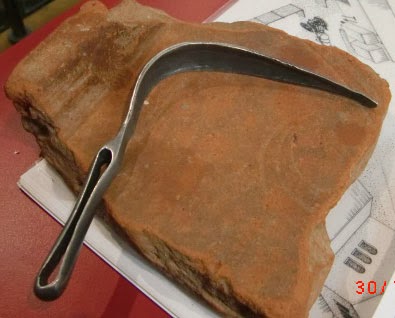
Let’s go back to the primary function of the Roman Baths: washing and getting clean. Contrary to what happens nowadays, water was not used to get washed, well not at first. Romans entered the Baths, disrobed and with just a cloth around their waist went in the steam and hot rooms (Calidarium and Laconicum) to sweat it out. There they would get oiled with fragrant unguents by the slaves working in the Baths – or their own personal slaves, if they were wealthy – when ready, the slaves would scrape off the sweat and dirt with the ‘strigil’ which is a fairly scary implement - from my point of view - especially if in the hands of someone you don’t trust 100% (although it is similar to when men go to have a wet shave and allow a total stranger to have a sharp razor to their throat!).

Strigil
 
Anyway, I am digressing… once the bathers had been cleaned up, they would step out of the hot rooms and move to the Frigidarium, the word indicates this was a much cooler room where you would let your body cool down (it was also a place where you would meet fellow bathers) before stepping into the Natatio, or swimming pool of cold water to finish the cooling process. This kind of process reminds me of the Finnish practice of going from the sauna to the freezing waters in northern temperatures…it seems old habits get retained here and there, so there must be some benefits…

In the Caracalla Baths we know there were also rooms, probably on the upper floor, where visitors could have a massage or sunbathe…

Roman historical talks


If this got you intrigued and would like to know more (and are based in Hertfordshire or neighbouring counties) you can book a talk on this or similar subjects (Domus Aurea (Golden House of Nero), Roman Aqueducts…).
I regularly speak to Archaeological & History Societies, WI, etc...
Look forward to hearing from you.

Thursday, 30 May 2013

Summer sizzlers, marinades and Pestle & Mortar

Summer is at our doorstep and with the last Bank Holiday weekend of good weather, gardens and BBQs are ready to please.

What to do with those fresh herbs that are growing in the garden or on the windowsill?


As nice as they are one feels that they need to have a purpose and be put to use...so how about using them for cooking? You can add them to a potato salad or to a green salad... yes, but...how about making something a little more creative, something that makes them gorgeously delicious and un-recognisable... something like a MARINADE.

They are used all the time in Eastern cuisine and they create the most intricate flavours out of simple ingredients like herbs and spices.

All you need is fresh herbs, some spices, a Pestle and Mortar and a recipe or your imagination.


Pestle & Mortar
Pestle & Mortar
If you are a novice in making a marinade and using a Pestle & Mortar, here are some very easy recipes to get you started and put you in the mood.

Pesto:
Put a large bunch of basil leaves, 2 tbsp. pine nuts, 2-3 cloves of garlic, sea salt and freshly ground black pepper in the mortar and start crushing them to a pulp with the pestle while slowly adding olive oil.  You want to have a paste that is not too runny and at the same time is loose enough to coat your linguine pasta. When you have the right consistency, add 2-3 tbsp. of  grated parmesan and mixed together (don't bash it with the pestle) mix it gently.
Cook your linguine as directed from the packet and when drained mix the pesto, you might want to add a little olive oil if too sticky.
Eat and enjoy!

Marinade for pork:
Mix together in your Mortar 4 garlic cloves, 2 tbsp. freshly grated ginger and add a tsp. of 5-spices powder. When  you have worked the pestle to make the garlic and ginger and spices into a paste, add soy sauce, hoisin sauce, 2tbsp. of clear honey and 2 tbsp. of sunflower oil.
Put the marinade onto some pork ribs and let it sit for several hours.  Cook on the BBQ. [Recipe from Chef Bill Granger]


Guacamole:
Place a small red onion, finely diced, 1/2 chilli pepper, 1 clove of garlic in your mortar and use the pestle to slowly mash together the ingredients. Add some coriander leaves and 2 ripe avocados.
When these are all amalgamated into a thick paste add 1/2 yellow onion, grated & its juice, the juice of a lime, salt and freshly grated black pepper.  You might also want to add a splash of tabasco sauce.
This is an easy and quick recipe to make and can be served with tortilla chips.

These are only some of the recipes you can make with your Pestle & Mortar. Use the pestle in a circular motion to grind the ingredients to a smooth paste.  The whole process is very soothing and it kind of takes you back to the primitive way of preparing food, or the way it is still produced in some cultures.

I have read that you can also prepare your own chilli paste with a Pestle & Mortar and that it is far better in taste than the mixtures you buy in a tin or jar.

If you don't have a Pestle & Mortar yet, this is easy to remedy. There are a lot of types on the market. I prefer the wood ones, in particular those made with Olive Wood. I like the feel of the wood and the fact that the ingredients and the Pestle & Mortar have all been live, earthy products.
Pestle & Mortar made in Olive Wood are also very cheap to buy and will provide a long lasting addition to your kitchen.

With Father's Day fast approaching (16th June) a Pestle & Mortar could provide the perfect, unusual present that will leave you with money in your pocket to buy food to marinade and put on your BBQ. What a great way to spend Father's Day! 


 Does your Dad already have a Pestle & Mortar, how about a Wine Bottle Holder then?


Monday, 22 April 2013

Roads in Tunisia & Queueing habits at coach stations

Roads

Motorway road from Coach
The first few days in Tunisia I was very impressed by their roads... the surface was smooth, black and it was a pleasure feeling the wheels run onto it (even as a passenger and not a driver).
That was until I was on a coach, Tunis bound. I had done the trip before and all was well until we got to a roundabout and, where the signpost was pointing to the motorway for Tunis, the police was standing blocking the way. Fortunately our driver knew his way around and slowly started driving though small villages and roads to join the motorway. And that’s when it hit me. Once outside the main centre, the roads are just dirt tracks or not yet finished. Once clear of Grombala – the town we were in - just off from the town centre the roads were barely there. Often just dirt, other times at the intermediate state of being built, but not yet tarmaced. At a certain point we had to go through a bridge. Barely wide enough for our coach. Obviously with cars in each direction – everybody must have been diverted – cars had to alternate to pass over it. Everybody was behaving reasonably well ... until a lorry driver in front of us went through and, from the other side, a ‘clever’ lorry driver decided he was ‘cleverer’ than all the other diligent drivers, waiting their turn on the bridge, and went on to overtake all the cars in front of him and block the way to the lorry that had been in front of us and that just at that moment - was passing through the bridge and narrow gaps... Road, narrow as it was, bridge also narrow and obstructed by now by our coach... perfect jam. Instead of hooting and so forth, as in a lot of other Mediterranean countries would have happened, the other drivers just stood still! Even made space for ‘clever’ lorry driver, so he could reverse back (and take the place in front of the queue)! Not a peep from everybody else!! A policeman on a motorbike did not see fit to intervene!
Overtaking sheep

The week before, I had met a Japanese woman, who had lived in Tunisia for 7 yrs. She plays the piano and was telling me that she was taking driving lessons and how difficult it was to drive when you have to contend with bad driving from other drivers, horses & donkeys, carriages, motorbikes and bicycles. I'm not surprised!
Donkeys and carts on the road

             
Cars and pedestrians in the middle of the road

Queues in Tunisia

And that takes me to the ‘queuing’. In principle Tunisian people do it (queuing), in practice there are some people that not only jump the queue, they also want to be ‘right’ when someone challenges them! Arghhhh.
The 1st time I went to Tunis was a Monday. I took the coach from Nabeul. I got up early in order to get there early as the last bus from Tunis was returning to Nabeul at 5pm!! When I got to the bus station, there was a large crowd. I found the queue to purchase a ticket for Tunis and got in line. A woman, yellow top (not easily forgettable) came after me and tried to jump the queue and infiltrate it at a point 4-5 people in front of me. The person she was directly jumping in front told her, in her own language, that the queue was further down and pointed to behind me. So what did the woman in the yellow top did? She went and tried to get the ticket from another window with a much smaller queue (dough!). Only that particular counter did not sell tickets for Tunis bound buses ... So having been told that, she got back to our side of the room and started a new off-shoot queue. Ours was snaking around seats and at the point of the bend leading to the ticket window, she started a new line. People are like sheep and started queuing behind her (of course the queue was much shorter!). Effectively the queue was split and making a second line of people that had arrived well long after us started queuing there... She was all pleased with herself... I kept on looking at her, and she kept on avoiding looking at me. Eventually the ticket window opened and they started selling tickets for our bus. The queues started moving on. Until we got to the narrowing when people had to enter a narrow gap between metal posts. As we got there I was right beside the woman in yellow. And guess what? Yes, she wanted to go first! Not a chance, lady!!!  I told her partly in French and partly in English that she knew she was behind me as she had been told before. She feigned ignorance, well she certainly was ignorant! After a bit of a tag of war, I managed to win and squeeze through the metal posts before her. Not sure what she said behind me, so I turned around and again told her that she had arrived after me and lots of other people and that she very well knew it and to stop thinking she had been wronged. One question that was unclear to me was why there was such a crowd. A woman in front of me told me that lots of people were going to Tunis to work and to study – university was already open (late august) and as being Monday morning it was a particularly busy morning. Didn’t help that they were selling tickets only once the previous coach had departed, and therefore creating the long queues of suffering people (it was already very hot at 7.30 am). On the way back, at the coach station in Tunis, things were much worse than in the morning. Here they were selling tickets all at once, apparently with time on the ticket, although difficult to read. It did not help the clocks on the forecourt had the wrong time (they were fast). So when the bus came I went to catch what I thought was my bus – in fact it was the previous one – and a ‘mob’ of people, mainly youngsters, assaulted the bus and started boarding it. Getting on the steps, then deciding there was no space for their shopping or suitcases on the bus and sending the cases back towards the waiting people and expecting those people to place them in the hold-hall ... I got stack in the crowd and was being suffocated, totally invisible to the young. Could not get out, legs, arms were crossing in front and behind me, I could barely move or breathe. I eventually managed to get on board; there was only a way forward within the 'mob' - only to be told my bus was the next one!
Fortunately the 15’ wait for the next bus managed to reduce the ‘mob’ and it was fairly easy and civilised to board my coach. Once on board, I realised that in the next bay was a bus going directly to Hammamet (where I was staying) and with hardly anyone on board! Two days later, when I returned to Tunis to visit the city, I still left from Nabeul in the morning, much quieter mid-week, and returned to Hammamet on the way back.
So you have been warned, do not travel by public transport to Tunis at the beginning of the week!

Friday, 15 March 2013

Nabeul market in Tunisia - a different way to shop and barter in foreign countries


Hammamet Market
Nabeul market, a busy street

Travel guides mention it, and when you go to Nabeul market you realise how expensive it is & how rude the locals are if they don’t get their way. Nabeul market is much larger than the one in Hammamet  – which I visited only a day before. This also had given me an idea of prices and, together with the one I had seen in a local supermarket just outside my hotel, I felt I was armed with knowledge and could easily compare prices and quality. 

Buying and bartering at a Tunisian market is not as fun as doing it at a Moroccan one. Tunisians seemed very rude and if you manage to agree a price, they became grumpy if they felt they hadn’t charged you way over the odds. I drive prices down as much as possible, especially if I have seen it before at a lower price. I also know that they won’t sell if it is not convenient to them and not making a profit. I have a budget and stay within it. 

Once the sale is done, I expect the other side to be pleased and not to hold a grudge.  They had a choice and I did not force them to sell to me, and I do not want them to try to make me feel guilty!   Having been several times before in Morocco and Turkey, I know that if they sell they make a profit, so cheer up Nabeulians! 

Nevertheless even after having encountered some very rude and begrudging people, I still managed to meet great lovely ones. In particular at Nabeul market I met again an old man and his son (?) whom I had seen the day before at the Hammamet market and I had purchased a few items from him.

with Bourawi
With Bourawi, market seller
I liked his jovial and welcoming (if a bit too overwhelming) approach. It certainly made a stark contrast with the other local stall holders. This man (Bourawi) had developed an immediate crush for me (!) - he wanted to come back to England with me which I drew a line to (it is very useful in this cases to have a story involving ‘loving husband or partner’ that is working hard at home and waiting for you to get back or joining you in a day or two, if you do not happen to have the ‘real McCoy’!) - anyway, Bourawi was the first to see me in Nabeul street market that Friday morning, while I was walking around hot and confused by the number of people.

Above the noise and hassling a friendly, welcoming voice rose and shouted: ‘Hallo my friend!!’ and I looked around to see a smiling face with open arms! 
You cannot believe how nice it was - after having been shoved and pushed by greedy sellers and harassed by pushy ones - to see a familiar face. He got me out of the crowd, offered a cool drink from a nearby stall seller and a seat!   Well, I supposed I felt like royalty! :-)
And you know, I bought a lot of lovely bits from him again, much more than the day before, as I had regretted not buying more of certain bracelets… It turned out my host was from Nabeul and had more of the stock I wanted and in different colours.
Berber Bracelet with semi-precious stones
I also bought two beautiful amber necklaces. Gorgeous. Did you know there is a way to test that amber is real amber?  With Amber, you stroke it hard against a cloth so it warms up and when you smell it, it has a nice aroma, kind of resin.

Or if you are buying camel bone, the real camel bone/hoof and not just plastic (as sometimes it looks and it is) can be tested by using a flame to barely touch the hoof/bone. It won't smell as nicely as amber, it will have a smell similar to the one of when you burn hair.
The way to usually do business in these countries is to sit and chat and sip a drink and bargain, and chat some more and then pick something else to add to the bargaining and you go on for a while. 
At the end you are happy and so are they. I love it when you find people like these, and hate it when I haven’t got scope to buy things from them, as they are so nice (like in the case of the potterer – see photo below) that you want to support their business.
The choosing, buying, bartering is a process that takes time, however I love it, as you get to know a tiny bit of the other person and culture which is partly what is all about for me.
Nabeul - pottery
At the end of my chatting/shopping/bargaining with my new friend (Bourawi) I was also given a present of a Fatima hand pendant in silver and a very nice chain to go with it - which he asked his son to put on my neck - and a little stuffed key ring camel.

Such graceful and nice people! As I finished with my friend, a few steps away, another  seller from the Hammamet market crowd popped up – the one the day before had been a bit grumpy after the sale– and that day he was a bit more charming. Again I bought two more bracelets from him (some the ones I had really wanted the day before) and managed to get them for a very good price.
Camel bone & Resin Bracelet
I wasn’t so lucky when I went back to a shop, just outside the market, where first thing in the morning I had seen some nice cushion covers and lovely decorated glasses to use as T-lights holders. When I went by in the morning there was a woman setting up the shop, and having asked for the prices, I had decided to buy up a few on my way back – as I did not want to carry them all the way through the market. Unfortunately though, when I went back to the shop around mid-morning, the young son and dozy grandma where there instead and the son was much too greedy and quoted me a much, much higher price than the one quoted in the morning.  I didn’t manage to convince him to see reason and sell them to me at his mom’s price. I had promised myself to go back there the following Friday, early in order to catch the woman while setting up the shop again. However, the following week I also wanted to be in Hammamet and in the end decided I didn’t want to go from pillar to post (Nabeul and Hammamet are at opposite ends from where I was staying) and didn’t fancy rushing around on my last day of holiday. 

I went to the Hammamet Medina instead and, eventually, managed to find a shop I had seen the first day of my holiday while wondering around. Boy what a maze is the Medina. And when asking direction, the ‘clever’ sellers thought they could confuse me and take me to their shops claiming to be the one I wanted… as if!  I had a picture on my mobile with the name on it … ;-)

Tuesday, 29 January 2013

Toe Rings

I have been wearing rings on my toes for many years. I suppose I started wearing them as I gradually stopped wearing the ones in my hands as I was gardening more and more and not often practical to wear or if I was wearing them I risked to leave them behind when washing my hands ... therefore wearing something, albeit on my feet was a way of sporting some jewellery.
I found the 1st of my toe-rings on a small street market stall in London. Only a few stalls in a street near Shaftesbury Avenue, which I happened by change on a week day – I don’t even remember why I was there.
I loved it. I am still wearing it. It is a nice band of silver with some a real small motive. I got used to wearing a toe ring pretty quickly and after that summer I decided I wanted to have another one for the other foot. In those days ankle bracelets were very fashionable and you think it would have been easy to find also toe rings... not the case. I happened upon my 2nd toe ring on one of the stalls of the market in Chancery Lane, we used to get there in our lunch break from the City and one summer I found one, not the best, but decent enough for me to buy it. However it was never very good: the metal, even though was supposed to me silver, would get dark very soon, and eventually snapped in two a few years back.
For a long time I could not find any toe rings and if I found one none that I liked. Until I went to Morocco one summer. In Agadir, I found a shop that sold local crafts at a fix-price and I found my next toe-ring. I bought it and wore it right away to the delight of the shop owner/assistant. As the ring was so comfortable, I decided to buy another one and to try to wear two rings on two different toes on the same foot. It worked; they were comfortable to wear and did not clash with each other causing pain. Before the end of that holiday I had bought several more, which I have given as presents and some form part of the Valentine Day Gift Ideas now.
A few summers ago – in Tunisia – I was looking to replace the toe ring which broke (see above) and I found it in a little shop outside the compound of my hotel in Hammamet. They had quite a few of them and some were really nice. As it happened after a lot of thinking I bought the first one that caught my eye. A little silver band with a small dolphin. I cannot remember the exact meaning of the dolphin for the Tunisian. I have checked it and the dolphin has been used since Greek mythology. Also nowadays is used in tattoos. Here are a links to website where you can read more if interested in the symbolism of the dolphin.

Last summer I met an Irish woman and she too was wearing toe rings. Her rings were really nice and I was interested in knowing where she had got hers. We got chatting and it turned out she wears them all year round. So this year (or rather last) when the first cold days settled in I kept on wearing my toe rings. Went to the swimming pool, wore them with tights (and they did not ladder them) and now I wear them with all sorts of close shoes even my walking boots!! (Although when really cold I prefer to take them off as my toes shrink and the rings are then too big for them!).
What I have learnt over the years and with the experience of wearing toe rings, is that toe rings to be comfortable have to be in real silver, have an opening – which allows you to place it over the large bits of your toes and then tightening it to fit the middle, slim bit of the toe – and be fairly solid without excessive protuberances.
Why, you ask? Feet get a lot of battering and any jewellery has to be strong enough to sustain the pressure the foot applies on ground, shoes and so forth.
Silver is easy to clean, doesn’t wear off and therefore your rings will always look the best. You want to be able to see them when you look down to your feet... vanity??

toe rings

toe rings on feet, front
I prefer mine not to have any big protuberances or stones as rings do turn from time to time, especially if cooler and your foot shrinks a little, and there is nothing worse or more painful than a sharp bit in between two toes – think of a ring with a stone and having a handshake that is very hard and squeeze your hand. Painful! Imagine the little toe in a similar situation (I am not saying someone is going to give you a foot shake!)
As I was saying I haven’t found very easy to buy toe rings. One summer the Tunisians – crafty people! – upon my inquiring would take me around to their shop only to be shown normal finger rings... they think they are clever:-~
As I was writing this article I have also done a little research and found that toe rings are a relatively new item of accessories used in the western world (that explains it!) and usually only one ring is worn on a single foot. However in India (I have not been there yet) it is something associated with a bride and they wear matching ones on each foot. Click here should you want to read more about it.

If you would like to purchase a toe ring, click on the link or go to www.craftsoftheworldonline.com and contact us.

Monday, 21 January 2013

Textile co-operative in a Tunisian village

I love reading travel guides of the countries I visit, 'Lonely Planet' and 'The Rough Guide' are usually best for me. Anyway, in one of these or both I found that in a Tunisian village - not far from where I was staying - there was a textile's co-operative where locals were working and producing products for the local and foreign markets. Even better, the village - Beni Khiar - had a sunday market! Yuppiee!! And so I set out to go to this village to find the co-operative.  I prefer to travel with public transport as a. it is cheaper; b. you get to meet the locals, see how they live/behave, etc... Sunday buses in Tunisia are not as frequent as other days of the week (nothing different from UK or other parts of EU, as far as I know), which meant my bus was late and when I got to Nabeul I saw the bus for Beni Khiar slip under my nose. :-( ... and the next bus was a couple of hours later!
So I set out to look for a taxi (I am not very fond of taxi or their drivers ...ssssssh, don't tell anyone!) and - having found one - I got in and shortly after we arrived in Beni Khiar. I must say, it was not very far at all - if you know where you are going - however a little bit too far to walk in the hot sun, even at 10.30am. Amasingly, although just outside the main town of Nabeul, capital of the Cape Bon area, Beni Khiar was so remote and rural!

Beni Khiar

As I said earlier, Beni Khiar is not big and it is on the outskirts of Nabeul, almost following on from it. When I arrived, the market was in full swing. Nothing different from what I'd seen in Beni Khalleb a week or so before - more on this in another blog - only smaller and less interesting. Still, I went through it - without being mobbed - quite nicely.


Market & Mosque in Beni Khiar


Police Station & market crowd
Having a chat while shopping
   Local wares  Portico in Beni Khiar


My reason for being in Beni Khiar was to find this co-op that I had read about on the travel guides. they said it was a place famous for wool and its weavers and that the co-operative was also selling its products directly.
The taxi driver dropped me in the middle of the village, not really knowing where the co-op was or caring about it. Very helpful! I started in the direction the taxi driver had indicated and soon found myself nearing the end of the village by the main street. Armed with my guides and phrase books (even my broken French was at times too much for the locals which only spoke Tunisian lingo) I approached some women in a shop. After much confabulating among themselves, they indicated back to the centre of the village, towards the market.
Back I walked, when I got back to the main square I saw the police station! What better place to ask for directions!?! So I went in ...


The ladies in the shop had indicated down the road. At the main square the road split hence the decision to pop in the Police Station. Nothing like you would expect. A large cavernous bare room with a wooden table by the door (for the breeze) and two people (cannot remember if they wore uniform) smoking and chatting and not terribly interested when they saw me entering...after much talking (among themselves) and asking other passers by and insistance (mine) that this co-op must be in their village as the tourist guides said so; finally, one of them remembered that there was a place with a textile co-op, they indicated the way and after more asking, I found the place I was looking for!
The walk to this place took me past many butchers shops, the 1st one I nearly hit the head of a huge cow's head hanging by the entrance!


As a non-meat eater I was not too impressed, and lets not talk about the smell of dead meat coming out of the fully opened fronted butcher' shops!


The Textile Co-operative

It is a shame I did not take a picture of the outside (this here is a scan from their leaflet).
 

There was a large wall at both sides, with some sort of mural showing the looms and materials... however somehow it was not as striking and did not stand out, hence missed (as being at the beginning of the village, I had gone by it in the taxi earlier on). There were no gates, so I approached.

The ground was a garden full of orange and other citrus trees. It reminded me of an old school
in the 60's - a bit decrepit - and I was expecting to be challenged any minute as a trespasser.   Instead, I reached a couple of buildings, one with a door opened, which I approached tentatively (see picture "Outside of co-op in Beni Khiar"). Walking in, I felt like an alien and also felt like stepping into a time machine, back in time. Inside the building there weren't many people, I asked if that was the co-op and a young-ish man came out of one of the rooms and - speaking part English and part French - we established I was in the right place. Having asked if I could look around, my host asked why I wanted to see the place. I told him the co-op was mentioned in my tourist guide and I was a tourist and interested, as I had come over specifically for this place. I am sure the young man and the other men around him thought I was mad! Anyway, he happily told me I could go and have a look upstairs and, when coming back down, he would show me the warehouse (which turned out to be a small room downstairs).   I walked upstairs and I found myself in a large room (the whole length and width of the building) full of looms, 15-18 of them.
 
 Looms at the textile co-op

The old fashioned looms were fascinating. In the room were ... men working at their loom and weaving various types of cloths. Some incredibly attractive to the eye (the cloths not the men! :-) ). 
 
 Man at his loom

Absolutely fascinating! Once again it was like stepping in the time machine and being back to the industrial revolution! How incredible to think that in this day and age people still make cloths in the old fashion way!!

Apparently the co-operative was set up in 1957 (as the leaflet I was later given told me). The men at the looms were really friendly and not at all bothered by my being there, they kept on weaving and said 'good morning' as I was wondering. They were also kind enough to let me take pictures (a lot of people in the Muslim world believe having a picture taken deprives you of something [soul]), this meant I was able to walk around taking picture and videos (see later) through the room.

At the end of the room, sitting on the floor was a very old man, he was working at a large sort of wheel - initially I thought it was a primitive fan! Infact it was something completely different.


He had lots of small cones, no longer than 10-15 cm and hollow inside. He put one on something pointed, sticking out of the wheel, he then wrang around it 4 different coloured threads - coming from wool cones sitting by his side - and with the help of the wheel/fan he spun the 4 threads together on the cone that was acting as a pipette. I suppose he was creating a twisted thread that was then used on the looms to weave the cloths. He seemed totally oblivious to me - or totally ignored me - I tried to film the whole scene... it is not the best as I was trying to be very inconspicuos.


In another part of the room, behind some looms and weavers, there were more of these 'wheels' and another man doing the same thing. He was almost hidden away.
As I was walking back downstairs I saw one of these wheel closer and it was made of wood and what looked like some kind of skin tightly stretched around it (see picture "Wheel and wool reels"). Very ingenous!
 
Downstairs, my 'guide' showed me the storeroom (rather than warehouse) as promised, which was full of types of materials, rugs, bed covers, satchels, cushions etc.
 
 Traditional overcoat  Satchel bags
 
 
I would have loved to buy a bit of everything. Some of the colours were very bright and fetching. However because they were made of wool and linen, and bulky - had to be mindful of the weight allowance on the plane - I was only able to buy three cushion covers (now sold in our online shop).
 
 Blue  Tunisian co-op cushion - green

I do hope that I will be able to get more stock if there is request for these. [I was told they do not have internet, so all communications need be done by mobile (hopefully) and snail mail] I'd love to be able to stock more of their products, they were lovely and some incredibly attractive!
 
I was told that the co-operative is mainly operated by men. Men weave and use the looms. Women work from home and - at my incredulous question of where the looms could fit in their small homes or did they have a small version of it - I was told the women cut, sew with colourful stitches and embroider creating the end products. All their products are produced manually.

Friday, 18 January 2013

Amber – What is Amber - Facts and Useful Information

Amber - What is Amber


Amber is fossilized tree resin (not sap), which has been appreciated for its colour since Neolithic times. Amber is used as an ingredient in perfumes, as a healing agent in folk medicine, and as jewellery. Because it originates as a soft, sticky tree resin, amber sometimes contains animal and plant material as inclusions. Amber occurring in coal seams is also called ‘resinite’, and ‘ambrite’ when found specifically within New Zealand coal seams.
The English word ‘amber’ derives from the Arabic anbar, Medieval Latin ambar and Old French ambre. The word originally referred to a precious oil derived from the Sperm whale (now called ambergris). The term was extended to fossil resin circa 1400, and this became the main meaning as the use of ambergris declined. In French "ambre gris" was then distinguished from "ambre jaune"; ‘ambre gris’ (gray amber) was ambergris; ‘ambre jaune’ (yellow amber) was the fossil resin we now call amber.
Theophrastus mentioned ‘amber’ - possibly the first historical mention of the material - in the 4th century BC. The Greek name for amber was ηλεκτρον (electron) and was connected to the Sun God. The modern terms "electricity" and "electron" derive from the Greek word for amber. Pliny the Elder mentioned the presence of insects in amber and mentioned it in his ‘Naturalis Historia’, this lead him to guess that amber might have been liquid at some point and able to cover the bodies of insects. Hence he named the substance succinum or gum-stone. The word "electricity" is derived from the Greek name for Amber, electrum. This is because amber can acquire an electric charge when rubbed. Thales described this magical property in about 600 BC - and it remains one of the most useful methods to identifying real amber in gold and silver jewellery. There have always been claims that amber rosaries and amulets can actually conduct current, discharging excess energy in the body. Amber has long been worn and carried by men, as a talisman against sexual impotence.
Beads of resins from tree, in time they will become amber
Amber will soften if heat is applied and it will eventually burn. This lead to it being named Bernstein or burn-Stone is German. If heated above 200°C, amber will decompose, producing an "oil of amber" and leaving a black residue which is known as "amber pitch" - which when dissolved in oil of turpentine or in linseed oil - forms "amber varnish".

How was it formed?

Molecular polymerization, resulting from high pressures and temperatures produced by overlying sediment, transforms the resin first into copal. Sustained heat and pressure drives terpenes* off, resulting in the formation of amber. Copal is an immature resin and it is sometimes passed off as amber. It is said to be immature because not all the volatile terpenes have left the resin via geological processes over millions of years. Therefore it is younger in age than true amber. [*Terpenes and terpenoids are the primary constituents of the essential oils of many types of plants and flowers].

Botanical origin

Fossil resins from Europe fall into two categories: the famous Baltic ambers and another. Fossil resins from the Americas and Africa are closely related to the modern genus Hymenaea (plant of the legumes family); while Baltic ambers are thought to be fossil resins from ‘Japanese Umbrella-pine’ used to live in north Europe.
Historically, the coast around Königsberg in Prussia was the world's leading source of amber. After 1945 the territory around Königsberg was turned into Kaliningrad Oblast, Russia, where it is now systematically mined. About 90% of the world's extractable amber is still located in Russia on the Baltic Sea and pieces of amber torn from the seafloor are cast up by the waves, and collected by hand, dredging or diving. Elsewhere, amber is mined, both in open works and underground galleries. Amber from the Baltic Sea has been extensively traded since antiquity.
Small fragments that used to be thrown away or used only for varnish, are now used on a large scale in the formation of "amberoid" or "pressed amber". The pieces are carefully heated with exclusion of air and compressed into a uniform mass by intense hydraulic pressure. The product is extensively used for the production of cheap jewellery and articles for smoking.

Geological record

The oldest amber recovered dates to the ca.320 million years ago. Other old amber specimens come from the Middle East: Lebanon and Jordan. This amber is roughly 125–135 million years old and is considered of high scientific value. Many remarkable insects and spiders were recently discovered in the amber of Jordan, including the oldest zorapterans, clerid beetles, umenocoleid roaches, and achiliid planthoppers. [Not sure I really want to know what they look like!]. Relics of flora occur as inclusions trapped within the amber while the resin was still fresh, suggesting relations with the flora of Eastern Asia and the southern part of North America.

Paleontological significance

Amber is a unique preservation medium, preserving otherwise unfossilisable parts of organisms - even their soft tissues - which are helpful in the reconstruction of ecosystems and organisms. As seen in the movie Jurassic Park, mosquitoes can still have the blood of their victims inside them, sealed and kept intact forever. It's no wonder Amber is a symbol of eternity and eternal divinity!
Amber sometimes contains animals or plant that became caught in the resin as it was secreted. Insects, spiders and their webs, annelids, frogs, crustaceans, bacteria, marine microfossils, wood, flowers and fruit, hair, feathers and other small organisms have been recovered in ambers dating back to 130 million years ago.

Appearance

Amber occurs in a range of different colours. From the usual yellow-orange-brown associated with the colour "amber", to a whitish colour through to a pale lemon yellow, brown and almost black, even (very rarely) violet.
Much of the most highly-prized amber is transparent, in contrast to the very common cloudy amber and opaque amber. Opaque amber contains numerous minute bubbles.
Sometimes amber retains the form of drops and stalactites, just as it exuded from the ducts and receptacles of the trees.
Amber can be classified into several forms:
• Natural Baltic amber – gemstone which has undergone mechanical treatment only (for instance: grinding, cutting, turning or polishing) without any change to its natural properties;
• Modified Baltic amber – gemstone subjected only to thermal or high-pressure treatment, which changed its physical properties, including transparency and colour;
• Reconstructed (pressed) Baltic amber – gemstone made of Baltic amber pieces pressed in high temperature and under high pressure without additional components;
• Bonded Baltic amber – gemstone consisting of two or more parts of natural, modified or reconstructed Baltic amber bonded together with the use of the smallest possible amount of a colourless binding agent necessary to join the pieces.
Amber increases in value with the rarity and perfection of the entrapped object. Complete insect specimens are rare and command top price.
Copal, is also a tree resin but it hasn't fully fossilized to amber. It is usually only thousands of years old, instead of millions of years. There is strong debate about some deposits of African amber as to whether it is copal or true amber.

Use

Amber has been used since antiquity in the manufacture of jewellery and ornaments, and also in folk medicine. Amber also forms the flavouring of ‘aquavit’ and it is used as an ingredient in perfumes.

Jewellery

Amber has been used since the Stone Age, from 13,000 years ago. Amber ornaments have been found in Mycenaean tombs and elsewhere across Europe. Nowadays it is also used in the manufacture of smoking and glassblowing mouthpieces. Amber is most often set in gold and silver jewellery. Mediterranean countries started to trade in Amber for jewellery making as far back as 2500 BC. Amber from this period has been found 600 miles from its place of origin. Amber was very popular and highly valued in this time period, because it is softer than minerals and was easier to work with primitive methods.

Historic medicinal uses

Amber has long been used in folk medicine for its healing properties. Amber and extracts were used in ancient Greece for a variety of treatments through to the Middle Ages and up until the early twentieth century.

Scent of amber and perfumery

In ancient China it was customary to burn amber during large festivities.
Although, when burned amber does give off a characteristic "pine-wood" fragrance, modern products, such as perfume, do not normally use actual amber. This is due to the fact that fossilized amber produces very little scent. In perfumery, scents referred as “amber” are often created to emulate the opulent golden warmth of the fossil.
Ambergris is the waxy aromatic substance created in the intestines of sperm whales and was used in making perfumes both in ancient times as well as modern ones. The scent of amber was originally derived from emulating the scent of ambergris, but due to the endangered status of the sperm whale, the scent of amber is now largely derived from labdanum [Labdanum is a sticky brown resin obtained from the shrubs Cistus ladanifer (conifers)]. The term “amber” is loosely used to describe a scent that is warm, musky, rich and honey-like, and also somewhat oriental and earthy. It can be synthetically created or derived from natural resins. When derived from natural resins it is most often created out of labdanum. Benzoin is usually part of the recipe. Vanilla and cloves are sometimes used to enhance the aroma.

Amber is technically not a gemstone or mineral

Early physicians prescribed amber for headaches, heart problems, arthritis and a variety of other ailments. In ancient times, amber was carried by travellers for protection. To the early Christians, amber signified the presence of the Lord. In the Far East, amber is the symbol of courage; Asian cultures regard amber as the 'soul of the tiger' and Egyptians placed a piece of amber in the casket of a loved one to ensure the body would forever remain whole.
It is worn for general good luck, financial stability and to ward off danger from witchcraft. It is rich in medicinal values and used for curing many chronic ailments.
The wearer must refrain from luxuries and temptations of life. It relieves of tensions and is good for those interested in social and humanitarian causes. It should be kept away from heat or sun.
Amber is highly recommended for those who often have to meet challenging situations and frustrating atmosphere. It is considered to brings a care free, sunny disposition, to promote good luck and success, and dissolve oppositions.
Healers use it for stomach, spleen and kidney complaints; joint problems and teething pain in babies.
The gemstone Amber is one of the birthstones listed for the Sun Sign for Taurus.
Powers attributed to amber include love, strength, luck, healing, and protection, calming for hyperactivity and stressed nerves, finds humour and joy. Legend says that Amber was believed to provide magicians and sorcerers with special enhanced powers.
Helps remove energy blockages, strengthens physical body. Excellent for enhancing consciousness. Amber represents the division between an individual's energy and cosmic energy, the individual's soul and the universal soul of all living things. It is the symbol of divinity. Ancient painters used the colour amber to denote the divine. The faces of gods and goddesses, heroes and saints were all painted amber.

How to recognise Amber

Several tests are known to determine whether your piece is real or not.
Baltic amber is considered the highest quality in the world. But because amber is a lightweight organic fossil resin, it is possible to imitate it by using lightweight plastics and synthetics. Some imitations are made with the purpose of creating false insect inclusions, rather than creating a false piece of amber in general. There are a few tests one can do to determine real amber from imitations.
Plastics are the most common amber imitations and can be distinguished from natural amber. Celluloid is composed of cellulose nitrate and camphor. Amber imitators of celluloid and glass can be distinguished from amber by the fact that when rubbed the imitation does not become electro-statically charged and gives off the odour of camphor. Amber becomes electro-statically charged when rubbed and like plastic both are warm to the touch and can be distinguished from glass, which is cool to the touch, heavier and has a higher specific gravity. The following tests are the most commonly available and easiest to perform. However care should be taken to avoid damage to the piece tested.

Static test
. This is the simplest and safest test. Amber is warm to the touch and when rubbed, it will become electro-statically charged and will attract lint & dust particles. This is what the ancient Greeks discovered and named it "electron", which is where we get the term "electricity".
It’s electric! Amber holds a charge of static electricity and was actually used to remove lint in earlier times. To see if your “amber” is static, place some small pieces of tissue on a flat surface. Rub the amber vigorously on the carpet or with a piece of velvet until it is warm and hold it closely above the tissue pieces. If the pieces of tissue are not attracted to the specimen, it is not amber. If tissue is attracted to the specimen, it may be amber.
Hot, hot, hot. Is your specimen warm or cold to the touch? Amber should feel warm when handled at room temperature.
Does it float? True amber floats in salt water. This is how it was discovered – floating on the Baltic sea. Amber is only slightly denser than saltwater, and can be carried vast distances by the sea. To see if your “amber” floats, dissolve two tablespoons of table salt in eight ounces of water. Drop your “amber” into the solution. If it sinks, it is not amber. If it floats, it is probably amber. This method only works if the amber is removed from its setting.
Pine fresh scent. Rub the specimen briskly on a piece of cloth until it gets warm, and then smell it. If it’s real amber, it should emit a mild pine or turpentine odor. If it smells like plastic or chemicals, it isn’t amber. Beware that if it has the right smell, it still may be copal.
The scratch test. Real amber has a hardness of approximately 2.5 on the Moh’s scale. This is quite soft, but your fingernail alone should not be able to scratch it. Try scratching your “amber” gemstone with your fingernail. If it makes a mark, it isn’t amber. If it doesn’t make a mark, it may be amber. This is an effective test in distinguishing copal from amber, as copal is very soft can be scratched with a fingernail.
Does it glow? Place your “amber” specimen under a short-wave ultraviolet light. If the specimen is fluorescence with a pale blue under the light, it may be amber. If it doesn’t glow at all, or glows a color other than pale blue, it is not amber. Copal doesn’t fluoresce.
Baby oil test. Drop your specimen into a clear glass of mineral oil (Johnson’s Baby Oil works fine). Mineral oil and amber have very similar refractive indexes. If the edges of the “amber” appear as a dark outline or light halo, the specimen is not amber. If it is difficult to distinguish the edges of the “amber”, it may be real.
Lick it. Wash the specimen with mild soapy water then rinse and dry thoroughly. Taste it – do you detect a chemical, strong, or unpleasant taste? If so, it isn’t amber. Remember, amber comes from the trees, so it shouldn’t taste unnatural or manmade. If the specimen has no taste (or one that is very subtle) it may be amber.
A Bug’s Life. If your specimen contains an insect or other animal, try to have it identified!!