Search This Blog

Showing posts with label pampering. Show all posts

Monday, 3 February 2014

Mix Turkish Baths and Hammam - Part 3

Mix Turkish Baths and Hammam: in which I tell you about visiting a Turkish bath near Ephesus and my 1st time in a Hammam in Marrakesh (part 3)

Hammans in Africa

Let’s jump ahead a few years when I was visiting Morocco for the 1st time. After having spent and experienced the in-house SPA of my hotel complex in Agadir, I arrived in Marrakesh. As my hotel didn’t have any of the facilities I had chosen it for (spa, entertainment), I spent as much time away as possible from it and this included taking the baths – or hamman – elsewhere.

If you have been to Marrakesh before, you’ll know that once in the Medina (old town) – and in most touristy places – you get handed out lots of leaflets for hammans. You have to be very discerning and, in my case, I wanted a place with character and not too touristy (although the latter is debateable) … so after nearly a week walking the streets of Marrakesh I came upon the Hammam Ziani.

During my most recent visit to Marrakesh I was told this Hammam is one of the oldest in town and it dates back to the xiv century. Although quite different from the Turkish baths in Istanbul, the Zian is also quite interesting. The inner area is not as grandiose or as big as the one in Istanbul – this is almost like an igloo, or better, a quarter size sphere just like the old roman ones.


They have light coming down from the vault via round holes filled with glass and all around the walls, water faucets fill concave capitels. There is something almost surreal for relaxing and taking the ‘baths’ in an environment full of history – at least for me!


Hammam Bab Daukkala


On another visit to Marrakesh I tried another Hammam: the Hammam Bab Daukkala which I found mentioned in the Lonely Planet pocket guide to Marrakesh. It seems this Hammam dates back to the 17th C.
This hammam is also in the  Medina – however in a less touristy area – and its entrance is just behind the Bab Daukkala Mosque (unfortunately non-Muslims are not allowed into mosques in Morocco nor Tunisia. Whilst it is possible in Turkey wearing adequate clothing).

Entrance to the Bab Daukkala hamman

The entrance to this hammam was nothing special and it was clearly used by locals, which were entering with buckets or washing up bowls, filled with towel, shampoos, etc.  I entered and paid the fee and was sent down a very dark corridor, which, after a sharp bend, took me to a large room full of semi naked women.
The room I entered was part of the changing room and it has a vault made of cedar-wood – beautiful and breath-taking, especially when sunlight filters through the star shaped openings in the dome. The inner rooms were once again vaulted in stone or stucco and had columns and capitels to which women, young girls & children leaned against while waiting for the ‘gommage’ (body scrub) or resting.  It had a very nice atmosphere and very matter of fact.

View of the Vault inside the hamman

When I got to the hamman I was not aware that it was a local place and therefore not equipped for tourists arriving and asking to be treated. As it was, I arrived to the Bab Daukkala Hammam hours after having landed from my flight from London/UK; and there I was with my flip flops and bottom part of a bikini and nothing else!! I had even forgotten my hairbrush! :-) In my elementary French I tried to explain my guide book said this was a place where I could get a gommage.

Around the periphery of the changing room were a few older local women, they seemed the one in charge and after a bit of surprise at my request and laughs, one of the women agreed to give me a gommage and massage and we agreed a fee. The chief older woman, sitting on the floor by the entrance to the changing room (she was like an old grandma), decided she will look after my handbag and so, after changing and with my belongings in her care, I entered the steam and hot rooms.

Inside the inner part of the Hamman 


These rooms – three of them all connected with each other – were vaulted and had columns ending with ornate capitels and marble decorated tubs collecting water from the taps. The 1st room had lots of mothers and daughters soaping up and scrubbing (gommage) young girls and little boys. There was laughter and cries of children playing or not wanting to be washed, all under the same roof in the same room.

When I finally emerged from my treatments, I was relaxed and scrubbed off of all the fatigue and dust from my journey earlier that morning.
Back in the changing room – no towel (they were not equipped for the public), no hairbrush... so I patted myself ‘dry’ with a few paper tissues and got dressed. As I did so, the chief women set up for their dinner and opened fragrant dishes of chicken and other food – and bless them they even offered me to join them! I thanked them profusely and declined – I only had my lunch an hour or so before… I found these women so nice and sweet. I would have loved to have a chat with them, however with my pigeon French and their main language being Berber, it was rather difficult.
Nevertheless the experience set the tune for my 2nd visit to Marrakesh and I left with a big smile on my face, with dripping and tangled hair in the warm December afternoon sun. What a difference from the -3C. I left in Gatwick earlier that morning!!

Hamman in Tunisia 


And what a difference my first - and probably last experience - of a hammam in Tunisia a few summers ago!
I was staying in Hammamet (which means the town of the Hammam, or so I was told) and I decided to try a real Tunisian Hammam.  After a few enquiries my Thomas Cook rep suggested a place which was situated not far from my hotel. Luck wanted that the day I visited I happened to arrive soon after a large contingent of French women from the hotel next to mine and therefore the Hammam was filled with lots of noise, prudery and queues… As usual the establishment had an entrance for women and a separate one for men. Although not equipped for the public (i.e. tourists) at this Hammam they were happy to yank up the price and take our money (typical attitude in all Tunisian places I visited).

This Hammam had been arranged on the ground floor of a block of apartment’s flats. Tiled with colourful tiles in the changing room and nothing else. Basic stuff in a modern surrounding, rather disappointing.
The treatments were also pretty disappointing, in fact rather painful.  The scrubbing was so vigorous that my arms and legs – which had been slowly kissed by the sun in the previous days sunbathing – the skin was so vigorously scrubbed to the point of rendering the already tender skin very raw and scratched! Ouch... Nothing of the nice feeling of soft clean skin after the Turkish or Moroccan baths experiences… rather the opposite…My skin – whatever left of it – was clean, unfortunately too much of it had been scrubbed off and it had gone past softness as more like very tender!

Back to the hammans I like most...


... and to the XIV century Hammam Ziani in Marrakech, only a few steps away from the Bahia Palace and well equipped to receiving tourists and wealthy locals alike. From the point of view of comfort this is probably my favourite, however the Turkish baths in Istanbul were much more attractive with their antique features in the hot room… And the hamman in Bab Doukkala is certainly the most colourful for the local folklore which I have visited.

What I like about going back to foreign places I have visited before is that I have my favourite spots – often not well known to the masses of tourists – where I can go and enjoy local culture mixed with some well deserved TLC!
Read also my other blogs on Roman baths and hammans…

Tuesday, 21 January 2014

Mixed Turkish Baths and Hammam - Part 2

Mixed Turkish Baths and Hammam

In which I tell you about visiting a Turkish bath near Ephesus and my 1st time in a Hammam in Marrakech.


After such a good time at the Turkish baths in Istanbul (see my Blog: Roman Baths/Hamman/Hammams - Part 1), I was eager to repeat the experience the following time I was in Turkey. As it was, I had joined a group of 10-12 people and we were touring part of eastern Turkey before boarding a gullet for the Turquoise coast.
We were on the 3rd-4th day of our trip and we were hot. 40+ C every day and even though we were travelling in an air-con minibus, we were hot and sticky. Our guide was a lovely young girl and when we reached a small town near Ephesus, we asked to visit a Turkish bath. She asked around and as luck would have it there was a local place and that afternoon it was the mixed evening.

Mixed Turkish baths 

Usually Turkish baths (and Hammam too) have separate rooms for men and women. I think this particular one was catering for the tourists and had mixed sessions.
So there we were into this small provincial Turkish bath – seriously the main room was much, much smaller than the one for women only I had been in Istanbul - a bit disappointing for me, especially as there were lots more people congregated in it and it was a fairly modern building and no antique features.
Anyway, here we were lots of us British, Germans, Dutch… all congregated in the ‘hot room’ and we were like sardines on the central marble platform, trying to relax and sweat it out whilst making an effort not to bite the foot of the person in front of us, millimetres from your mouth and avoiding to get in contact with the people either side of us. And … the masseurs were men!!
Old – they seemed very old – wizened old men. I must say they were good in their art and I received a vigorous strong massage. They also asked permission to wash you under your bathing top… however, it wasn’t the best or more relaxing experience! I put it down to experience and ever since I have only taken women only Turkish baths and manage to relax plenty.

Going to the barber…to get a massage 


Before we step into another continent’s bath story (or should I say Hammam) let me tell you what happened the afternoon after our experience at the mixed Turkish baths … One of our party decided he wanted a wet shave as he had tried it once before whilst in Turkey and “there was nothing like it”. In our free time, three of us went looking for a barber. Now – I know I said this town was equipped for tourists; obviously the vicinity of Ephesus made it a good stopping point – however hardly anyone spoke English! So, there we were, trying to find a barber, not a Turkish dictionary between us, and lots of miming and finally, in a little back square, we find one!

The shop was rather old fashioned – it had one of those spinning red and white poles outside (not working) and inside had very old fashioned push up barber chairs [like the one you see in old American movies, where the bad boss is having a shave when someone attempts to murder him].
We entered the shop and – like in the saloons in western films – all conversation stopped. Our friend mimed a shave and sat in a chair he was pointed to and proceeded to enjoy his wet shave, which also included a rather nice massage of arms and shoulders, all the while us two waited sitting in the shop.

I love massages and, while waiting for our friend to have his shave and massage, I started hankering for a massage too. After our friend had finished and paid, I asked him if he thought it was ok for me to pay the same and only have the massage…seconds later we explained to the barber and his assistants what I wanted and, among baffled locals, I sat on the chair just vacated by our fellow traveller.

The chair was so high I could touch the floor when elevated and my feet dangled in the air. You have to imagine the stupor of the locals: a woman sitting in a barber’s chair…! And so, among general amusement, I got a shoulder massage by the barber’s assistant and then two young lads (barber’s sons?) each got hold of my arms and started massaging – rather vigorously and at times painfully – my arms. It was fantastic! It did not last more than 5-10 minutes max and it really un-knotted all the muscles in my shoulders… when finished I stepped down and paid. They did not want me to do so… therefore I gave the money to the young masseurs, who were delighted.
We stepped out of the barber shop and a few more curious faces were lingering around to see this extravagant European woman who had been sitting in the barber’s chair to get a massage! :-) What a laugh… even thinking about it now brought a smile to my face and brought me back to that summer evening. I must confess the following day I had bruises on my arms where the strong little fingers had so vigorously massaged my arms! Price you pay for being unconventional...

Tuesday, 7 January 2014

On Roman Baths in ancient Rome and how they were used…

The Romans were quite clever as they thought that if they provided good standards of living, people would be happy and ever more so, the people living in the countries they had conquered. Therefore building roads, aqueducts and baths were seen as some of the primary improvements the Roman implemented in newly conquered countries and territories. In days of no sanitation, water, roads or drains the Roman provided huge improvements to the standard of everyday life. Hard to believe nowadays from our civilised lives and cultures…

Roman Road and drains (Tunisia)

As homes did not have running water, very often not even the more luxurious houses belonging to the rich, being able to wash regularly, being able to clean off the dust and grime after having travelled or walked on dusty roads (there was no tarmac!) must have been a real luxury!
Therefore, at least in Imperial Rome, all rich and poor were allowed to enter the Roman Baths and get clean for free. In the case of the Caracalla Baths – the best preserved, visible and perhaps most accessible in Italy – when they first opened access was totally free, later - when given to a ‘management company’ to maintain and regulate their use - an entrance fee was introduced, however it was merely nominal and affordable by even the poorest person.

View of Caracalla Baths from the gardens (Rome)

Going back to who and when one could access the baths in ancient Rome - when the bath were first opened - access to the baths was at different times/days for men and women. The baths were opened from noon to sunset and the Caracalla Baths – had approx. 6000-8000 visitors a day and up to 1600 an hour! This gives us an idea of how popular the Baths were.


Antonine Baths in Carthage (Tunisia)


Within a short time, women started protesting that they were being discriminated against (sounds familiar?) and eventually they were allowed in the Baths at the same time as the men. Historical notes record of amorous trysts and so on…

What were the Roman Baths for? 


They were primarily a place to get clean. However, as the buildings reached the scale of the Caracalla’s or the Diocletian’s Baths, they also provided a place to meet, relax, play and watch games, read – there were libraries in the baths complex – and where plots and conspiracies and lover’s trysts developed. The Roman Baths were the place of major games and sports (i.e. wrestling) and they were the equivalent of say Wembley Stadium in London. People would congregate to watch their favourite athletes compete.

How to take the Baths 


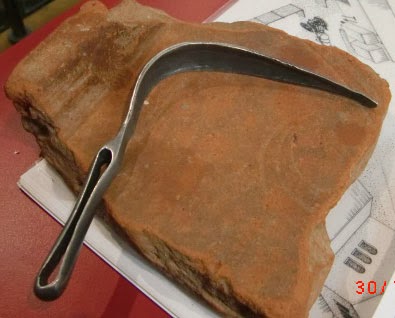
Let’s go back to the primary function of the Roman Baths: washing and getting clean. Contrary to what happens nowadays, water was not used to get washed, well not at first. Romans entered the Baths, disrobed and with just a cloth around their waist went in the steam and hot rooms (Calidarium and Laconicum) to sweat it out. There they would get oiled with fragrant unguents by the slaves working in the Baths – or their own personal slaves, if they were wealthy – when ready, the slaves would scrape off the sweat and dirt with the ‘strigil’ which is a fairly scary implement - from my point of view - especially if in the hands of someone you don’t trust 100% (although it is similar to when men go to have a wet shave and allow a total stranger to have a sharp razor to their throat!).

Strigil
 
Anyway, I am digressing… once the bathers had been cleaned up, they would step out of the hot rooms and move to the Frigidarium, the word indicates this was a much cooler room where you would let your body cool down (it was also a place where you would meet fellow bathers) before stepping into the Natatio, or swimming pool of cold water to finish the cooling process. This kind of process reminds me of the Finnish practice of going from the sauna to the freezing waters in northern temperatures…it seems old habits get retained here and there, so there must be some benefits…

In the Caracalla Baths we know there were also rooms, probably on the upper floor, where visitors could have a massage or sunbathe…

Roman historical talks


If this got you intrigued and would like to know more (and are based in Hertfordshire or neighbouring counties) you can book a talk on this or similar subjects (Domus Aurea (Golden House of Nero), Roman Aqueducts…).
I regularly speak to Archaeological & History Societies, WI, etc...
Look forward to hearing from you.

Tuesday, 21 May 2013

Roman Baths/Hamman/Hammams - Part 1

In my ‘previous’ life I used to be part of the Educational Dept. of the Archaeological office, one of the official bodies associated with the ministry of Arts and Culture in Rome (Italy).
Having studied Fine Arts at Uni and Medieval Art for my MA, I enjoyed the role given which allowed me to see a lot of sites in Rome which were closed to the public and/or open very rarely only to special delegations which needed a guide.  As such I used to research and prepare my talks in various libraries, where - once again - entrance was only allowed to ‘selected’ ones.  Oh, how I enjoyed that!

It was, during those two years that I got to know the Caracalla Bath (Thermae) [Caracalla because this roman emperor took over from his father – emperor Septimius Severus – in the completion of this grandiose opera, he gave it his name]. 


Caracalla Baths, South view

I will dedicate a post to describe the function and sequence of bathing in roman times.  In the meantime I will tell you about my experience of Turkish baths, Hamman and so forth in the XXI century.

Since living in Britain I learned and developed a love for being pampered. 
And when I first visited Istanbul ca. 14 years ago, I studied my guide book to find things to do in the two ½ days off from my tour guide – [I had been told to visit this city only as part of a group as not safe for a woman alone, so I joined a tour organised by The Ramblers Holidays.  I found Istanbul a very safe and friendly city, easy to navigate and would not hesitate to go back on my own]. 

While perusing my guide book I came across a Hamman based in a very old roman building.  I believe the present Hamman occupies the area and perhaps shares part of the old roman baths.
After visiting this 'Turkish bath house' I was hooked. 
This was a magical place to fully indulge and relax.  You entered, paid and would change into no more than a bathing suit and a small piece of cotton cloth wrapped around your waist.

Sarongs
 
Then you entered the Hamman inner sanctum and you found yourself in a semi large room full of steam and light filtering through from the ceiling.  You’d go to the side of the room where taps and small bowls are at the ready for you to douche yourself and take your position on the marble platform at the centre of the room. 
The platform is heated from underneath.  Think of being at the beach, and replace the sand for a warm marble slab and the sun bright light filtering from the ceiling, and a warm steamy air around you.  When you reach the central platform you crawl your way over other ladies and reach the centre. Here you lie down, using your cloth as a towel and relax.  As you are doing so, you take stock of your surroundings and that is when I focused on the provenience of the light.  The domed ceiling is scattered with small round holes which are covered by thick glass, almost like bottle ends.  When is light outside and sunny (as often is) the light filters through the glass and illuminate the room/s.  Through the steamy air you see rays of light cutting the steam and touching a capitel or column, a body being washed, a tap...
(Light filtering in the Hamman - www.hammamguide.com/).

After a while, you are drying and slowly starting to sweat and slowly you move towards the border of the marble platform and eventually you’ll be the next in line to be washed, scrubbed and massaged. The women (in this case) have sort of ‘pillowcases’ full of a local nicely fragranced soap which produces foam that is deposited on your body (have a look at the pictures on this site [http://www.virtualtourist.com/travel/Middle_East/Turkey/Istanbul_Ili/Istanbul-1837624/Off_the_Beaten_Path-Istanbul-hammam-BR-1.html]  to give you an idea).

The scrubbing is done with hands gloved with sort of loofah and it gets rid of all the dry skin cells on your body (so even if you have just showered, you feel very conscious of how much comes out while scrubbing!), then you get massaged, your muscles are kneaded and you come out a new person. Heaven! 
At the end of the process (you get done front and back) the women take you to the outside edge of the room, and rinse you and give you a shower.  All this is done very gently in a relaxed and sometimes laughing atmosphere and in the end you are clean, relaxed and your skin reminds you of a baby’s bottom for its softness.  As you leave the steamy room you are led to a cool down area, with beds/reclining chairs, where you spend the next ½ hr or so chilling out, half asleep and sipping the wonderful mint tea they are so famous about.

When I first took a Turkish bath I was still working in the City in London and holding an often stressful job, and my first thought was that if they were to transport the Hamman to London I would be a regular frequenter, certainly every Friday after 5pm and possibly on other days too to ease the tension in the muscles! 
Unfortunately the closest thing I found to the Turkish bath in London, was a long way away from the Istanbul ones and did not do the trick.
Ps. for obvious reasons I was not able to take pictures of the inside of the Hamman I visited, hence the links to pictures I could find on the net to give you an idea of what it looks like inside. (You might have to copy + paste the links to open them).