Search This Blog

Thursday, 28 March 2013

Marrakesh – walking and shopping in the Souks in the Medina


Last time I was staying in the Medina and decided to embrace the souks and getting to know them. Walking through the souks, you often end up getting lost, however after a couple of days I managed to find my way around a bit and also found myself connecting the dots - so to speak - between different areas and finding myself unexpectedly close to ‘home’ and/or not a long way away. What a sense of achievement, feeling you getting to grips with the city, you are starting to know it. I love it!
:-)
Going back to your favourite shop or café/restaurant. I tend to stay away from the big touristy restaurants. And, as I have allergies and do not eat meat, it is rather restrictive where I eat. Nevertheless I found some brilliant places to eat or take away food.


I suppose when you first go though the souks they all seems very similar. However once you get some firm points you can move from there. You need to believe that all connects with each other and eventually you’ll get close and where you want to be. It seems a nice, clear map of the souks is unobtainable. Perhaps it is all part of the trick to let you get lost in them, like in our supermarkets where they change the shelves/food aisles layout to ‘encourage’ you to buy things you usually do not need or want.
Same in Marrakesh, either that or to give work to the guides, official or not, who then get paid, therefore making it another way to boost the local economy. The souks are a city within the city (the Medina is). The souks are  differently named and the names are defined by the trade based in and around that area. So you get the ‘babusher’ for the leather slippers and the one for the dyers, and so forth. Which is kind of handy if you know what you want to buy and you can aim straight to that ‘quartier’ and have plenty to choose from.


It is harmless to go through the various alleys and street and squares. The trick is not to be lured into all the shops and only when you feel like it. I often find the one that do not harass you and drag you in, are the best. You need to follow your instinct and I found a lot of very nice people that have a love for what they sell and make. I like mostly the artisans, not so much the shop keepers who are just trying to shift another item. In all or the majority of the souks you find motorcycles speeding through despite the crowds. There are also the occasional tricycle and lots of bicycles and carts. The worse are the motorcycles as they produce huge amount of fumes, which I find pretty toxic when inhaled. Not sure if this is due to the mix of petrol & oil they use – different from ours – and/or also to the large number of motorcycles in such confined and enclosed spaces that makes it for a not very nice air quality to breath in, as well as having to be pretty much on the alert as they spring out from nowhere behind you!
   

As I mentioned shopkeepers do their best to get you into their shop and buy. They start the conversation with ‘bonjour, comment se va?’ (Good morning, how are you?) and it is handy if you know a few phrases of French to be able to reply. Although my 20 year old ‘Moyen’ level French is now pretty rusty, I am told my pronunciation is good, it helps, I suppose, that I speak Italian. However it makes it complicated as I need to translate from English to Italian, and then from Italian to French as most words and phrases are similar. Nevertheless I've often wished I could speak it better, especially when bartering so I have just bought an online a refreshers course on CD to listen in the car, I reckon 30+ minutes a day, it will do the trick and put it in my ear and refresh both my vocabulary and phrases. Will let you know.

Souks and sellers


Anyway, back to what we were discussing... Marrakeshi souks sellers. Even though I respond to the ‘Bonjour’ I often keep on going. Some of the more pushy shopkeepers shout at you ‘just looking’ hoping, in so doing, to invite you in their shop… I think they do not fully understand the meaning of the phrase… do not let me put you off window shopping! It is the best part. You need to be firm if you do not want to buy. They will trick you and kind of making you feel guilty. Do not be fooled! You don’t want to buy, you do not buy. No matter how far in your negotiations you have gone, or how many bags, shoes, carpets, etc. they have got down from the shelves. Enjoy the experience. I tend to ask prices first and also look at the quality. Once I decide the shop I want to buy from I get in and chat with them.


One of the things that drive me mad in Morocco is when you ask about the price and they reply to you with another question: ‘How many?’ Arggghhhh! Even though it would make sense that the more you buy the better the price, many years ago I found it not necessarily true when I found myself in a small Moroccan town. I wanted some of the lovely colourful typical bowls and set about asking prices. It followed a sort of tag of war. Finally I was given some prices, different colour had different prices. So, as I was going about choosing some bowls, I was mentally adding up the price. At the end I put them on the table and my idea was to bargain – as that is the norm – however the guy quoted me a price higher than what I had totalled up having used his prices - given to me a few minutes before – so I left without buying anything. I found having a base price is essential, and then you can decide if you want more than one and so forth before starting haggling. It is also the case of what you think it is worth it.


Last time I was in Marrakesh however I was ‘done’ on a small bottle of Sprite. I asked for the price at a small bar/shop and was told 6 dirham. Fair enough, I knew a similar size bottle of water was a little bit cheaper so I accepted the price in good faith, paid and left. Once out of the shop I cleaned the top and side before opening it and ‘oh and behold’ there was a pre-printed price on the plastic bottle: 3 dirham!! What could I do!?! Annoying though. I did not go back as I was a few paces away from the shop and had already opened it. It wasn’t so much the money, really pennies, it was the principle!
You have been warned and have lots of fun as you go around.


Friday, 22 March 2013

Easter Traditions

Have you ever wondered why Easter’s Day is on a different date every year?  Well, many years ago the Church decided that Easter Day would always fall on the Sunday following the first full moon after the first day of Spring (21st March).  This meant that Easter could be as early as 22nd March or as late as 25th April on any given year in the West, such as in UK, America, etc., where the Gregorian calendar is used; in the East, where the Julian calendar is adopted, Easter could be as late as May.

Easter is the most important of the Christian religious festivals.
Long before Christianity people in Europe worshipped the Goddess of Spring, 'Eostre'.  They believed that the Sun died in winter and was re-born again in Spring (easy to believe in UK and some Nordic countries!).  They thought that Eostre brought back Spring and that it would encourage the Sun to get stronger.  Some believe that Easter’s name derives from this Goddess.
In most countries though, Easter is called a variation of Pasch (Passover), which remains the name most used in non-English language countries.

Easter is preceded by a period of abstinence – Lent.  Historically, before Lent began, eggs - as well as other rich food - would be eaten in every household before Lent began.   This accounts for Mardi Gras (Fat Tuesday) or Shrove Tuesday (Pancake Day) the day before Ash Wednesday, the day which Lent officially begins.  Both in Western and Eastern Christianity, eggs, meat and dairy products were prohibited during Lent.  Pancake Day originated by the need to use all the eggs in the household before the period of Lent began.
In the Orthodox Church, Lent begins on a Monday, rather than on a Wednesday, to give more time to use up all the ingredients in the house before Lent.  As chickens could not be stopped from laying eggs during Lent – and in the old days it would have been difficult to store eggs for as long as 40 days – any egg that did not hatch would be preserved by being boiled to lengthen its edible life.  This has confirmation in the many recipes containing hard boiled eggs or eggs in general as a main ingredient, that are found in many countries (i.e. Spain-Hornazo, Hungary, etc.) as typical Easter’s recipes.

With the arrival of Easter, eggs could be eaten again.
Before Christianity, giving eggs at Easter was associated with the celebration of new life as well as a practical gesture - as 40 days without eating eggs must have left households with an excess of them and they would have been particularly welcome by people without chickens as well as not eaten eggs throughout Lent.  The egg is traditionally associated as a symbol of fertility and rebirth.  Eggs were thought to be special because although they do not seem alive, they have life within them, especially when chicks hatch out at springtime.

The tradition may also have merged into the celebrations after Lent.  It seems that the custom of Easter eggs originated in Mesopotamia.  And that the Christian Church officially adopted the custom of regarding eggs as a symbol of the resurrection, in 1610.
Parallels between Christianity and the celebration of Passover in Judaism are also notable because of Christ celebrating Passover with his disciples on the evening before Good Friday.

In addition, eggs have been viewed as symbols of new life and fertility through the ages. It is believed that for this reason many ancient cultures, including the ancient Egyptians, Persians and Romans, used eggs during their Spring festivals.  Slowly the tradition of giving eggs developed into a tradition of giving gifts of eggs carved from wood, precious stones, etc.   

Decoration and symbolism


In the Orthodox and Eastern Catholic Church, Easter eggs are dyed red to represent the blood of Christ.  Easter eggs are blessed by the priests at the end of the Vigil (the Saturday before Easter Sunday) and distributed among the presents.

Easter eggs are a widely popular symbol of new life in Eastern Europe (Bulgaria, Poland, Romania, Russia, Ukraine, etc.).  Eggs are decorated by using a batik process which is used to create intricate, brilliantly coloured eggs.  The best-known are the pysanka or pisanka from Ukraine and Poland (see further on).
An example of intricately decorated eggs are the FabergĂ© eggs.  Be-jewelled eggs created for the Imperial Russian Court at Easter.  Most of these creations contained hidden surprises such as clockwork birds, miniature ships, etc. 
Easy to see how the custom to give an egg at Easter has developed into the Easter egg of nowadays.

When boiling eggs for Easter, a popular tan colour was achieved by boiling the eggs with onion skins. A greater variety of colours was often provided by tying the onion skin to the egg with different coloured yarns.  In Northern England these eggs are called pace-eggs or paste-eggs, which derive from the middle-age English: ‘pasche’.

The first sweet eggs to be eaten, were created in the last 100 years, and were made from sugar or marzipan. Since then chocolate eggs have become popular and these are now mainly given on Easter Sunday.
Nowadays around 80 million of chocolate eggs are eaten in Britain each year.


Pysanka or pisanka


The pysanka is an Ukrainian Easter egg, decorated using a batik method with wax.  The word comes from the verb ‘pysaty’ - to write. The designs were written on the eggs with beeswax.
In Ukraine pysanka are typically made to be given to family members. Giving a pysanka is to give a gift of life, and for this reason the egg must remain whole.  Each designs and colour applied to the pysanka has a symbolic meaning and traditionally the designs were chosen to match the character of the person that would receive the pysanka.


Origins of colouring eggs at Easter in England


Decorating and colouring eggs for Easter was a common custom in England in the middle ages. Eggs were brightly coloured to mimic the fresh colours of Spring. The practice of decorating eggs was made even more popular when King Edward I ordered 450 eggs to be covered in gold-leaf and coloured as Easter gifts in 1290.

Easter egg traditions


"Egg tapping", "Egg rolling", "Egg dance" are some of the names of games played with eggs at Easter in different nations across the globe.

In the Mediterranean countries, chicken eggs are boiled and decorated with dye and / or paint and used as decoration around the house or to create Easter trees.  In some countries on Easter Sunday there is also the traditional egg hunt, where eggs are hidden outdoors (or indoors if the weather is bad) for children to run around and find them.

Easter eggs for the visually impaired (I like this)

It seems that since 2008 the 'International Association of Bomb Technicians and Investigators' have sponsored a charity in US to build Easter eggs for visually impaired children. Each year beeping Easter eggs are built emitting various clicks and noises that visually impaired children can easily find when hunting for Easter eggs.


The Easter Bunny

Symbols

In the legend, the bunny or rabbit / hare carries coloured eggs in his basket to the homes of children, a little bit like Father Christmas. It was first mentioned in a book 'About Easter Eggs' in 1682. [ "De ovis paschalibus" of Georg Franck von Frankenau.].

The hare was a popular motif in medieval Christian art.


In ancient times it was widely believed (Pliny, Plutarch among others) that the hare was a hermaphrodite (an organism that has reproductive organs normally associated with both male and female).  The idea was that a hare could reproduce without loss of its virginity, led to an association with the Virgin Mary.

Eggs, like rabbits and hares, were fertility symbols in antiquity.  As birds lay eggs and rabbits / hares give birth to large litters in the early spring, these became symbols of the fertility of the Earth at the time of the March equinox.

Friday, 15 March 2013

Nabeul market in Tunisia - a different way to shop and barter in foreign countries


Hammamet Market
Nabeul market, a busy street

Travel guides mention it, and when you go to Nabeul market you realise how expensive it is & how rude the locals are if they don’t get their way. Nabeul market is much larger than the one in Hammamet  – which I visited only a day before. This also had given me an idea of prices and, together with the one I had seen in a local supermarket just outside my hotel, I felt I was armed with knowledge and could easily compare prices and quality. 

Buying and bartering at a Tunisian market is not as fun as doing it at a Moroccan one. Tunisians seemed very rude and if you manage to agree a price, they became grumpy if they felt they hadn’t charged you way over the odds. I drive prices down as much as possible, especially if I have seen it before at a lower price. I also know that they won’t sell if it is not convenient to them and not making a profit. I have a budget and stay within it. 

Once the sale is done, I expect the other side to be pleased and not to hold a grudge.  They had a choice and I did not force them to sell to me, and I do not want them to try to make me feel guilty!   Having been several times before in Morocco and Turkey, I know that if they sell they make a profit, so cheer up Nabeulians! 

Nevertheless even after having encountered some very rude and begrudging people, I still managed to meet great lovely ones. In particular at Nabeul market I met again an old man and his son (?) whom I had seen the day before at the Hammamet market and I had purchased a few items from him.

with Bourawi
With Bourawi, market seller
I liked his jovial and welcoming (if a bit too overwhelming) approach. It certainly made a stark contrast with the other local stall holders. This man (Bourawi) had developed an immediate crush for me (!) - he wanted to come back to England with me which I drew a line to (it is very useful in this cases to have a story involving ‘loving husband or partner’ that is working hard at home and waiting for you to get back or joining you in a day or two, if you do not happen to have the ‘real McCoy’!) - anyway, Bourawi was the first to see me in Nabeul street market that Friday morning, while I was walking around hot and confused by the number of people.

Above the noise and hassling a friendly, welcoming voice rose and shouted: ‘Hallo my friend!!’ and I looked around to see a smiling face with open arms! 
You cannot believe how nice it was - after having been shoved and pushed by greedy sellers and harassed by pushy ones - to see a familiar face. He got me out of the crowd, offered a cool drink from a nearby stall seller and a seat!   Well, I supposed I felt like royalty! :-)
And you know, I bought a lot of lovely bits from him again, much more than the day before, as I had regretted not buying more of certain bracelets… It turned out my host was from Nabeul and had more of the stock I wanted and in different colours.
Berber Bracelet with semi-precious stones
I also bought two beautiful amber necklaces. Gorgeous. Did you know there is a way to test that amber is real amber?  With Amber, you stroke it hard against a cloth so it warms up and when you smell it, it has a nice aroma, kind of resin.

Or if you are buying camel bone, the real camel bone/hoof and not just plastic (as sometimes it looks and it is) can be tested by using a flame to barely touch the hoof/bone. It won't smell as nicely as amber, it will have a smell similar to the one of when you burn hair.
The way to usually do business in these countries is to sit and chat and sip a drink and bargain, and chat some more and then pick something else to add to the bargaining and you go on for a while. 
At the end you are happy and so are they. I love it when you find people like these, and hate it when I haven’t got scope to buy things from them, as they are so nice (like in the case of the potterer – see photo below) that you want to support their business.
The choosing, buying, bartering is a process that takes time, however I love it, as you get to know a tiny bit of the other person and culture which is partly what is all about for me.
Nabeul - pottery
At the end of my chatting/shopping/bargaining with my new friend (Bourawi) I was also given a present of a Fatima hand pendant in silver and a very nice chain to go with it - which he asked his son to put on my neck - and a little stuffed key ring camel.

Such graceful and nice people! As I finished with my friend, a few steps away, another  seller from the Hammamet market crowd popped up – the one the day before had been a bit grumpy after the sale– and that day he was a bit more charming. Again I bought two more bracelets from him (some the ones I had really wanted the day before) and managed to get them for a very good price.
Camel bone & Resin Bracelet
I wasn’t so lucky when I went back to a shop, just outside the market, where first thing in the morning I had seen some nice cushion covers and lovely decorated glasses to use as T-lights holders. When I went by in the morning there was a woman setting up the shop, and having asked for the prices, I had decided to buy up a few on my way back – as I did not want to carry them all the way through the market. Unfortunately though, when I went back to the shop around mid-morning, the young son and dozy grandma where there instead and the son was much too greedy and quoted me a much, much higher price than the one quoted in the morning.  I didn’t manage to convince him to see reason and sell them to me at his mom’s price. I had promised myself to go back there the following Friday, early in order to catch the woman while setting up the shop again. However, the following week I also wanted to be in Hammamet and in the end decided I didn’t want to go from pillar to post (Nabeul and Hammamet are at opposite ends from where I was staying) and didn’t fancy rushing around on my last day of holiday. 

I went to the Hammamet Medina instead and, eventually, managed to find a shop I had seen the first day of my holiday while wondering around. Boy what a maze is the Medina. And when asking direction, the ‘clever’ sellers thought they could confuse me and take me to their shops claiming to be the one I wanted… as if!  I had a picture on my mobile with the name on it … ;-)

Saturday, 2 March 2013

Moroccan humour or trying it on? Little artisan man

This is where cultural barriers might make it hard to communicate...

Last year (2011) my friend and I spent a w/e in Marrakech and to this day we are still wondering if the guy in the video tried it on or it was really his ‘Moroccan’ sense of humour.

My friend was looking for Xmas presents and wasn’t very impressed with the Moroccan selling style and took the view of approaching and buying only from people/sellers that were not harassing her. 
This is how we came across this artisan, who very quietly was going on with his business in a little alley of the Marrakechi Medina. 
We went around his place of business in the course of two days. Yes, no, yes, maybe, shall I buy it, or maybe not? My friend found the choice of goods available in Marrakech overwhelming and making a decision on what to buy & who for became a major decision-making choice (which was driving me mad!!)... Eventually she decided on some wood boxes.
Goods were checked, price agreed, goods wrapped and paid. Then little artisan man decided to produce a little something which – according to him – was a purveyor of good luck if placed in the bedroom (we never got to discover how it would bring good luck!). I stood aside, not wanting to be a disruptive element in my friend's purchasing process or the carving of such ‘lucky’ charm. 
Once all was concluded, items purchased, charm carved I was all ready to move on. ..But no, little artisan man decided he wanted me to have a lucky charm too; he insisted I sat down next to him and watch him as he was doing the carving. 
My friend and I swapped seats. As I started watching him I thought I might as well make a short video of it. I asked little artisan man for permission to film him and he agreed, so I proceeded to take the video. While he was carving various people passed by and stopped to take pictures. As you will see from the video all was amicable and relaxed.....

(Now watch the video)
You can imagine my shock at his request! Hence the sudden termination of the video as I stood up and left, soon to be followed by my friend – who told me later - had her jaw to the floor by the surprise of the request!

Our next stop was another artisan, known by me for his leather notebooks, and where my friend had decided she was going to purchase some lovely boxes covered in brightly coloured leather. We got to this other shop a few lanes away in the Medina and a few minutes after we got there little artisan man (the one of the wood carving) joined us and gave me the lucky charm he had finished carving in the meantime.  And all seriously he told me "it was all a joke"!


To this day I am not sure if it was a joke or not.   Watching the video and listening to the conversation again, I realised he asked for Euros and not Dirham (Moroccan currency).   So maybe it was a joke. On the other side why not saying something right away as he saw our reaction? And all the time he was ever so serious! I am still not convinced it was a joke....but maybe...? If it was, it certainly show the difference in cultures, even in the way we joke and make humour, as we certainly did not take it as a joke!
You can make your mind up and let me k now what you think.

Saturday, 23 February 2013

Mother’s Day, Mothering Sunday, Mothers Day...around the world (Part 2)

Part 2

Mother’s Day, Mothering Sunday, Mothers Day...you name it


Mother’s Day in USA

Mother’s Day - History

The history of Mother's Day goes back many centuries – as far as the Egyptians. Early Christians celebrated the Mother's festival on the fourth Sunday of Lent to honour Mary, the mother of Christ. Later on, a religious order included the celebration of all mothers and named it as the Mothering Sunday. English colonists settled in America discontinued the tradition of Mothering Sunday because of lack of time, however in 1872 Julia Ward Howe organized a day for mothers dedicated to peace. This was a landmark in the history of Mother's Day.
The English colonists that settled in America discontinued the tradition of Mothering Sunday because of lack of time. In 1872 Julia Ward Howe organized a day for mothers dedicated to peace.

Julia Howe had become very distraught by the deaths during the Civil War that she called on all mothers to come together to protest against what she perceived as senseless killing. With this in mind she organised an international Mother's Day celebrating peace and motherhood. This has become the landmark in the history of modern Mother's Day.

Julia Howe even proposed to convert the 4th of July into Mother’s Day and dedicate the day to peace. However the 2nd June was designated for this celebration and in 1873, 18 women’s groups celebrated this new Mother’s holiday in cities across North America.

Even not successful Julie Howe has planted the seed and in 1907 Anne Jarvis from Philadelphia set up a group to celebrate Mother’s Day and to honour of her mother. The first Mother's Day was a church service honouring Anna's mother to which Anna handed out white carnations, her mother's favourite flowers. Anne Jarvis' hard work paid off when in 1914, President Woodrow Wilson proclaimed the second Sunday in May as a national holiday in honour of mothers. The celebration became more and more popular and it became more commercialised.

Anne Jarvis was not happy about this and in 1923 sued to stop a Mother’s Day event and sale of flowers. During the 1930's she was arrested for disturbing the peace at the American War Mothers group.

Watch the video to see what became of Anne Jarvis

Anna Jarvis died in 1948, blind, poor and with no children. She never knew that the care she received during her last years of her life had been paid anonymously by The Florist's Exchange.

By the time of her death, over 40 countries observed the Mother’s Day. Today white carnations are given to remember deceased Mothers, and pink or red to pay tribute to Mothers who are alive.

To this day every year the American President is required to proclaim Mother’s Day holiday shortly before it is due and while he proclaims the event a group of mothers, who has lost a child in the a war, set up a protest against war. Mother’s day in America is celebrated the 2nd Sunday in May.

Mothers Day in some parts of the World


The majority of countries celebrating Mother's Day do so on the second Sunday of May.

Some of the countries celebrate Mother’s Day:


Canada - Canada was one of the first nations to pick up the US version of Mother’s Day.

Argentina - Though most of South America observes Mother's Day in May, Argentina celebrates it the 2nd Sunday in October. This is due to the country’s being located in the southern hemisphere. This corresponds to Argentina’s springtime.

India - A westernized version of Mother's Day is officially observed on 10th May mainly in large cities. However, Hindus have been celebrating Durga Puja – a divine mother derived from ancient Greece – with a 10 day festival in October. This festival is now one of the biggest events in India and families spend weeks preparing food and gifts.

Japan - Japanese Christians were celebrating Mother’s Day based on the American practice. During and after WWII the practice was banned along with all other western customs. After the war, however, the tradition was taken up again to help comfort to the Mothers who had lost children in the war and by 1949, the celebration of Mother's Day had again spread throughout the country associated with an art contest for children. The event was held every 4 years and the children would enter a drawing of their mothers, and the winning drawings would tour through Japan with an art exhibition celebrating Mothers and Peace. Today the Japanese celebrate Mother's Day on 2nd Sunday of May.

Asia & Australia as well as many Asian countries celebrate Mother’s Day drawing on from the American’s tradition.

Bahrain - In Bahrain Mother's Day coincides with the first day of spring, observed as March 21, the same is in Lebanon and the United Arab Emirates.

China - China’s Mother’s Day draws heavily from the United States’ tradition and carnations are a very popular gift and the most sold type of flower. In 1997 it this day was set to help poor mothers, especially in rural areas such as China's western region. The official government's Chinese newspaper, explained in an article that even though the tradition originates from the States, Chinese people can accept the holiday because it is in line with the country's traditional ethics of respect for the elderly and parents.
In recent years there has been other non-governmental suggestion to celebrate Mother’s Day in memory of Meng Mu which is supported by 100 Confucian scholars. This group also asked to replace the carnations with lilies, which in ancient times, were planted by Chinese mothers when children left home. This festival remains unofficial and it is only celebrated in a small number of cities

Hong Kong - Hong Kong’s holiday is noted for its custom to pay respect to the parents of the mother, if she is deceased.

Italy - The Italians celebrate the day with a big feast and a cake. Typically Italian schoolchildren will make something to bring home to their mothers and the family will take care of the chores for the day. Mother's Day in Italy was celebrated for the first time on 12th May 1957, in Assisi thanks to the initiative of a parish priest. The celebration was so successful that the following year it was adopted throughout Italy, where since then it is celebrated on the 2nd Sunday in May.

Sweden - Sweden’s Mother’s Day, which takes place on the last Sunday in May, has a strong charitable focus: the Swedish Red Cross which sells small plastic flowers leading up to the holiday, with the proceeds raised being given to poor mothers and their children.

Thailand - Perhaps the most unique Asian Mother's Day holiday takes place in Thailand. The celebration coincides with the birthday of their beloved queen, Sirikit Kitayakara, who has reigned since 1950. Her birthday, and therefore Mother's Day, takes place on 12th August.

Germany - In the 1920s, Germany had the lowest birth-rate in Europe. At the same time, influential groups in society thought that mothers should be honoured. These groups had one belief in common: the celebration of the values of motherhood. In 1923 this resulted in the unanimous adoption of Mother's Day which they imported from America and Norway and in 1925, the Mother's Day Committee started focusing the holiday as being about the level of population Germany. The holiday was seen as a means to get women to bear more children, and nationalists saw it as a way of rejuvenating the nation. The holiday did not celebrate individual women, but an idealized standard of motherhood. Some local authorities decided to make the holiday a day to support economically larger families or single-mother families and subsidies were given to families in economic needs.

During 1933–1945 with the Nazi party in power all changed radically. They started promoting the role of mothers as that of giving healthy children to the German nation. The Nazi party's intention was to create a pure ‘Aryan race’. Also the government promoted the death of a mother's sons in battle as the highest embodiment of patriotic motherhood.

This new official Nazis spin brought discontent among organizations such as the Catholic and Protestant churches and local women organizations. Local authorities resisted the guidelines from the government and kept assigning resource to families that were in economical need.

In 1938 the Nazi’s government started issuing an award ‘Mother’s cross’, with different categories depending on the number of children. The cross intended to encourage having more children, and recipients had to have at least 4 children. The award promoted loyalty among German women and it was a popular even though it had little material value. The winners of the award had to be examined by doctors and social workers according to genetic and racial values that were considered beneficial. Friends and family were also examined for possible flaws that could disqualify them, and they had to be "racially and morally fit". Among the criteria they had to be ‘German-blooded’ and they could not have vices like drinking. Criteria against were, for example, ‘unfeminine’ behaviour like smoking or poor housekeeping. Even contact with a Jew could disqualify a potential recipient. Application of policies was uneven as doctors promoted medical criteria over racial criteria, and local authorities promoted economical need over any other criteria.

Nowadays Mother’s Day is celebrated on the 2nd Sunday of May like most European counties.

Mother’s Day Trivia


  • In the vast majority of the world's languages, the word for "mother" begins with the letter ‘M’;
  • A mother giraffe often gives birth while standing, so the new born first experience outside the womb is a 1.8-meter drop;
  • Just like people, mother chimpanzees often develop lifelong relationships with their offspring.

Monday, 18 February 2013

Woburn Crafts Fair


It is all due to Ros, who is tirelessly organising the CCC - Crafts, Cake, a Cuppa fair once a month, as well as being a cat lover and a dab hand at painting them too!!
Yesterday (Sunday 17th February) saw the 1st event of 2013. And what a glorious day it was!
The sun was shining and temperatures reached 8 degrees C outside, inside the Woburn Village Hall temperatures were sizzling!

By 10.00am all stall holders had their displays ready and it was clear the room was filled with great talents.

Beautiful cards and paintings with attractive Watercolour-Flowers-Paintings were directly opposite me and delightful to look at; at my side great pin-boards in a range of backgrounds to suit every taste and mug warmers, an ideal present for Mother's Day by Just Quirky.


I managed a quick look around before the public started flowing in the hall and I was impressed.

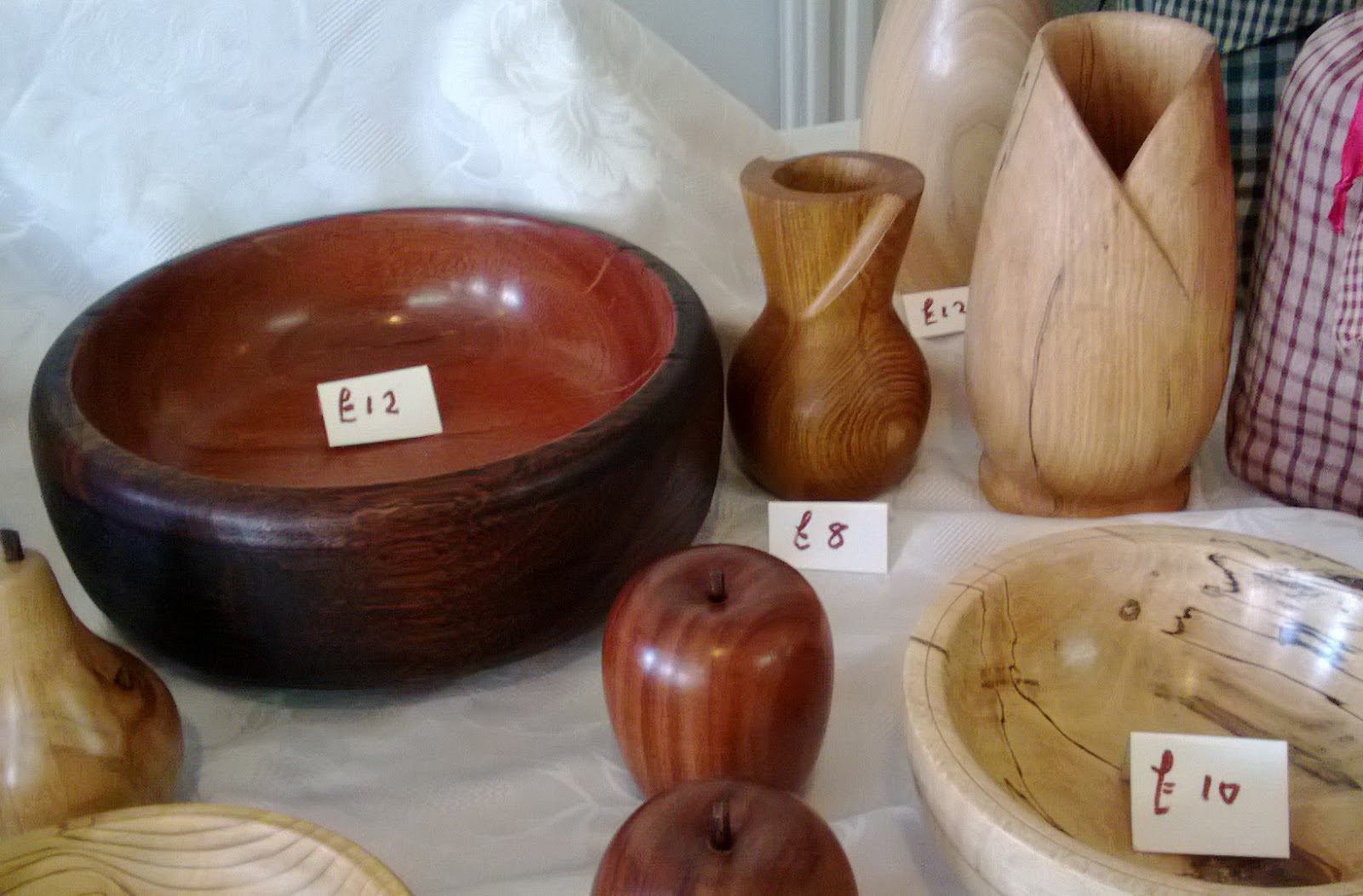
My eye was caught by beautiful glass cake stands and the wood turning objects on the stall next to me.


Directly opposite the entrance the public was welcomed by a table full of butterflies.  What a show, colourful, local and exotic, smaller and larger ones and all made of ... paper. What a talent!


Of course you could top up your food reserves too.  Outside the Hall in the main part of the village, the Farmers Market, which runs the same 3rd Sunday of the month as the craft fair. Inside the hall lots of homemade preserves and local honey as well as olives; a table full of tasty cup-cakes, and let's not forget the coffee/tea shop, run by Ros' husband that offered warm drinks as well as a selection of sweet and savouries. You would not go hungry even if you tried!


If you like handbags you would have felt at home with 3 stalls displaying an array of handmade bags to suit all.  From denim to designer bags you were spoiled for choice and all at very reasonable prices.

With Spring approaching and Mother's day and Easter only a few weeks away you could find a present for your mum or a wee blanket for that new baby's arrival.


All in all Woburn and the CCC - Crafts, Cake, Cuppa Fair is a destination to keep in mind on the 3rd Sunday of the month as a place to keep amused and entertained all the family; and for those wanting a walk on the 'wild' side what better place than taking a walk on the Woburn Estate among deer or visit the Safari Park. 


Saturday, 16 February 2013

Mother’s Day, Mothering Sunday, Mothers Day...you name it (Part 1)

Mother’s Day, Mothering Sunday, Mothers Day there is enough to confuse the best of us. And why is it celebrated on different days of the year and not on the same day everywhere in the world? As Mother’s Day is fast approaching again this year – 10th March – let’s discover its history, traditions and do on around the globe. Let’s start form our doorstep: UK.

Mothering Sunday vs. Mother's Day

Nowadays Mothering Sunday is often called Mother's Day in UK and it is regarded as synonymous with Mother's Day, as celebrated in other countries around the world, although many still prefer the more historically accurate ‘Mothering Sunday’.

Mother’s Day - History

The history of Mother's Day goes back many centuries – as far as the Egyptians. Early Christians celebrated the Mother's festival on the fourth Sunday of Lent to honour Mary, the mother of Christ. Later on, a religious order included the celebration of all mothers and named it as the Mothering Sunday.

Spiritual Origins of Mothers Day

The practice of honouring Motherhood is rooted in antiquity, and past rites had strong symbolic and spiritual tones and tended to celebrate Goddesses as the symbol of Mothers. The maternal objects of adoration ranged from mythological female deities to the Christian Church itself. Only in the past few centuries did celebrations of Motherhood develop a decidedly human focus. This human aspect to Mother’s Day is relatively new.

One of the earliest historical records of celebrating a ‘Mother’ deity can be found among the ancient Egyptians, who held an annual festival to honour the goddess Isis, who was commonly regarded as the Mother of the pharaohs. The festival of Isis was also celebrated by the Romans who used the event to commemorate an important battle and mark the beginning of the Winter. Despite being an imported deity, Isis held a place at the Roman temple. However the root in the Roman’s Mother’s Day is perhaps found more precisely in the celebration of the goddess Cybele, or Magna Mater (the Great Mother). Cybele derives from the Greek Goddess Rhea, who was the Mother of most of the major deities, including Zeus. Rhea was celebrated as a mother goddess, and her festival took place around the time of the Vernal Equinox (Spring equinox). In Rome and Asia Minor (Roman Empire), Cybele was the major Mother deity similarly to Rhea, the mother of the Gods in Greek culture. The Roman celebration of Cybele or Magna Mater fell around the 15 and 22 of March, at a similar time the Greek would have celebrated Rhea.


Modern times celebrations

Another holiday / festival to celebrate and honour Motherhood came from Europe. It fell on the 4th Sunday of Lent (the 40 days of fasting preceding Easter Sunday). Early Christians initially used this day to honour the church in which they were baptized, and that they saw as their ‘Mother Church’.

In the 1600's a decree in England broadened the celebration to include all real Mothers and referred to the day as Mothering Day. During this day - Lenten Sunday - servants and trade workers were allowed to travel back to their towns of origin to visit their families. Mothering Day also provided a one-day reprieve from the fasting and penance of Lent so that families across England could enjoy a family feast and represented a day where mothers were the main guest of honour. Mothers would be presented with cakes and flowers and overall mothers would get to see their distant children.

Mothering Day or Mothering Sunday in United Kingdom and Ireland

Early Christians in England celebrated the Mother's festival on the 4th Sunday of Lent to honour Mary, the mother of Christ. In the 16th century people working out of their homes were expected to return to the "mother" church (the spiritual power that gave them life and protected them from any harm).

In the United Kingdom and Ireland, this celebration is known as Mothering Sunday. The practice of visiting one's ‘mother’ church every year on the Lenten Sunday, meant that most mothers would be reunited with their children as young apprentices and young women in service were released by their masters to make the journey home that weekend to go visit their families.

In some Church of England churches, this day is the only day during Lent when marriages can be celebrated.

In the early 1900s (1935), the practice of celebrating Mothering Sunday fell into disuse. However, after the 2nd World War the tradition started to be revived, partly inspired by efforts made to revive the festival in the 1910s–1920s; it wasn't until after World War II when American soldiers brought Mother's Day celebrations to the UK and they were incorporated with the tradition of Mothering Sunday which was still being celebrated by the Church of England. In the 1950s the celebrations started gathering memento as were seen as a great commercial opportunity.

Irish and British people started to celebrate Mother's Day on the 4th Sunday of Lent, the same day on which Mothering Sunday had been celebrated for centuries before. Some of the old Mothering Sunday’s traditions were revived, such as the tradition of eating cake on that day, although nowadays Simnel cake is eaten instead of traditional cakes eaten in the olden days. The two celebrations have now mixed up and many people think that they are the same thing.

Recently the day was dubbed ‘Mother's Day’ or ‘Mothers' Day’ however sometimes ‘Mothers Day’ is also used.


Mothering Sunday, also known as...

Other names attributed to the festival of Mothering Day were: Refreshment Sunday, Mid-Lent Sunday, Simnel Sunday and Rose Sunday. Simnel Sunday as baking Simnel Cakes to celebrate the reunion of families during Lent. Rose Sunday is sometimes used as an alternative title for Laetare Sunday, as witnessed by the purple robes of Lent being replaced by rose-coloured ones in some churches.

Simnel Cake – Facts

Nowadays the Simnel cake is strongly associated with this holiday. It was also that Simnel Cakes became associated with Mothering Sunday as young servants/maids were allowed to bake a cake to take home to their mother as a gift. Fruit cakes known as "Simnel Cakes" became one of the most common gifts on Mothering Sundays;


  • Around 1600, when the celebration was only held in England and Scotland, a different kind of pastry was preferred;
  • In England they served a cake called "Mothering Sunday Buns" with raisin and butter icing;
  • In Northern England and Scotland some preferred "Carlings", a pancake made of steeped peas fried in butter.
As with most Mothering Sunday customs and traditions, the Simnel Cake has also a religious flavour: on top of the cake are placed 11 marzipan balls, signifying 11 of the 12 apostles of Christ, excluding the notorious apostle Judas, who had betrayed Jesus.